Key Takeaways
- Space has shifted from government exploration to a commercial growth story. Private companies now account for a majority of orbital launches, launch costs have fallen substantially since the 1960s, and the global space market is on track to surpass US$1 trillion in the next decade.
- Satellite-based services are expected to represent almost two-thirds of all space revenue by 2034, with connectivity and data services growing roughly three times faster than the broader market, driven by expanding networks for broadband internet, GPS, and defence intelligence.
- The Global X Space Tech Index ETF (ORBX) offers exposure to the global space economy — from rocket builders and launch systems to satellite operators and data services – capturing the full commercial space value chain.
The global space industry represents an unexplored economic frontier. As the Internet in the 1990s laid the groundwork for Artificial Intelligence in the 2020s, space infrastructure could lay the foundation for the next phase of the global economy. This blog looks at the growing space economy and a way for investors to access it.

Introducing the Global X Space Tech Index ETF (ORBX), which offers exposure to companies engaged in the growing space economy in the following sub-sectors:
- Rocket Launch and Reusable Rockets: Providers of launch systems and reusable rocket technology, reducing costs and increasing access to space for cargo, satellites, and missions.
- Space Tech & Components: Companies delivering the hardware, software, and analytics that power modern space operations — from specialized engines and orbital transport systems to satellite imagery, AI, and data solutions.
- Satellite Telecommunications & Data Services: Companies delivering global connectivity through satellite networks — enabling broadband internet, GPS, and secure communications — as well as those designing and manufacturing satellites, spacecraft, and related systems.
- Space Transportation, Tourism, and Exploration: Companies providing human spaceflight ventures, from orbital tourism to deep space missions, commercializing space travel as well as offering orbital discovery services.
Artemis and The New Industrial Frontier
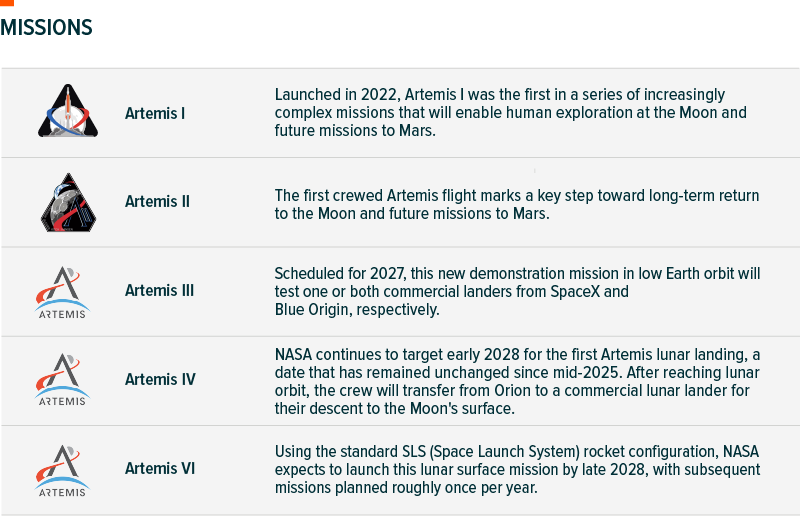
NASA’s Artemis II mission – with a crew that included London, Ontario’s Jeremy Hansen – was humanity’s return to the moon for the first time in over 50 years. Costing almost US$24 billion, the mission was the first crewed flight of Boeing and Northrop Grumman’s Space Launch System (SLS) rocket and Lockheed Martin’s Orion capsule. The successful mission paves the way for a crewed lunar landing set for 2028 with the eventual goal of establishing a permanent presence.
Source: National Aeronautics and Space Administration
The Artemis program also demonstrates how space exploration has now become a space economy, expanding beyond the era of government-led missions into the current age of public and private companies driving commercial growth and unlocking a new economic opportunity in the skies above the Earth.
The Path to Commercialization
The shift from government programs to commercial enterprise has been underway for decades, beginning with private satellite launches for communication services. But the pace of that transition has accelerated sharply as launch costs have declined and technology has matured.
Space is no longer defined by programs like NASA’s Apollo missions or the Space Shuttle. It is becoming an infrastructure layer, comparable to the Internet, that supports a growing range of activities and services on the ground.
Getting to Orbit
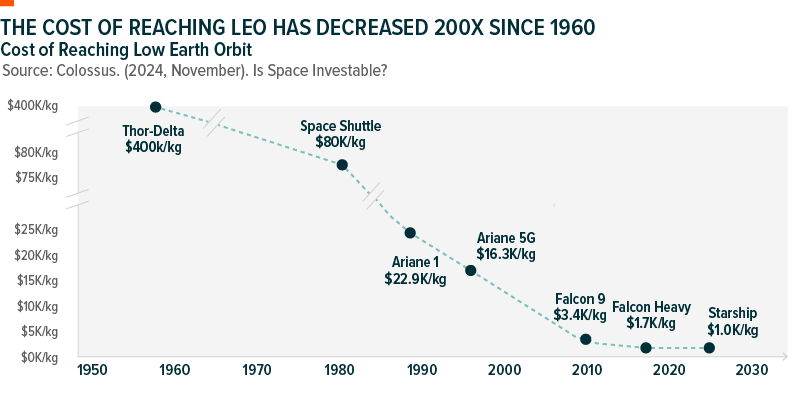
The economics of reaching orbit have changed fundamentally. Technological advances and reusable rockets, such as SpaceX’s Falcon 9 and Falcon Heavy, have transformed the cost structure of the industry, making access to space more affordable and enabling business models that were previously unviable.
SpaceX has achieved approximately a 97% success rate1 on reused components, making launches more predictable and cost-efficient alongside their lower price.
The numbers reflect that shift. Launch costs into Low Earth Orbit have fallen roughly 200 times since the 1960s.
Annual satellite launch activity has risen from approximately 85 launches in 2016 to around 325 in 2025, with the U.S. accounting for approximately 52% of global launches last year2. The commercial launch market is projected to reach approximately US$70 billion by 20353.
Orbital Opportunities: Satellites
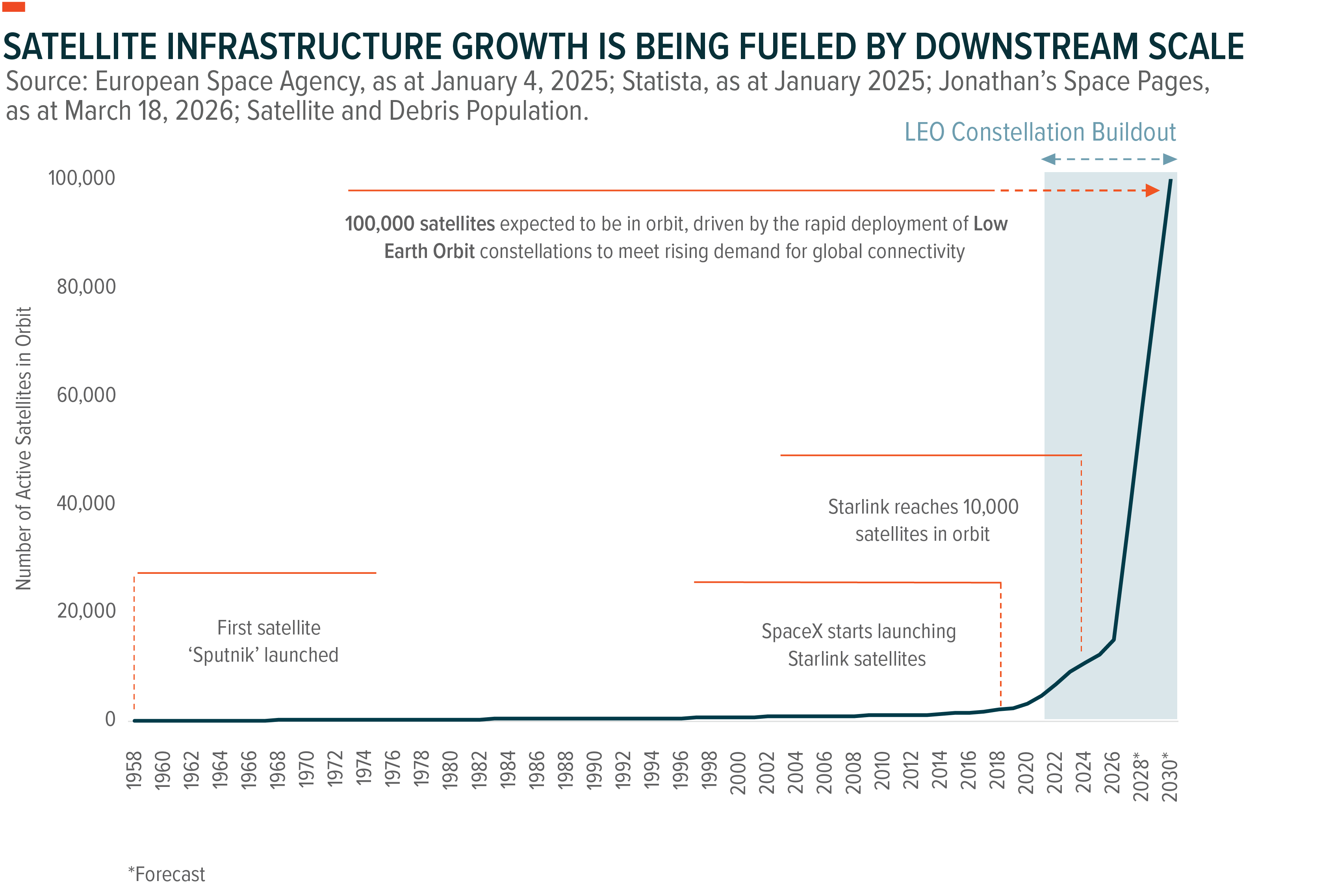
The growth in launch activity has fuelled an expanding ecosystem of satellite-based services. Starlink alone has approximately 10,000 satellites in orbit and roughly 9.25 million users as of early 20264.
Beyond connectivity, the satellite services market extends into a broad range of downstream applications: climate monitoring, logistics visibility, precision agriculture, and defence intelligence. Connectivity and data services are expected to grow roughly three times faster than the broader space market5. Taken together, satellite-based services are expected to represent approximately 63% of all space revenue by 20346.
A New Defence Domain
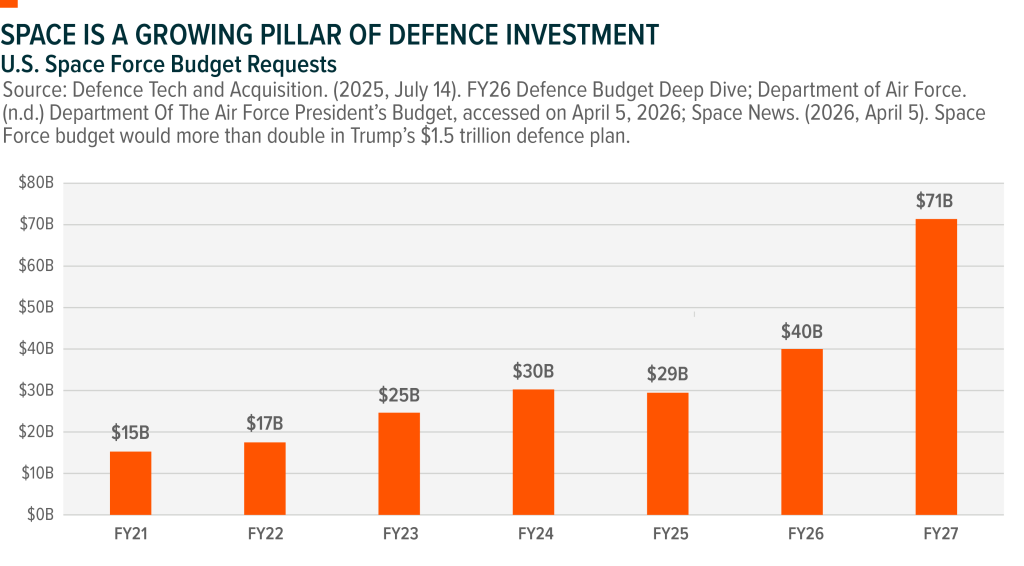
Space has also become a theatre of strategic operations. Governments worldwide spent US$137 billion on space in 20257, with just over 53% of that spending on defence related. Space-based systems are now central to missile warning, communications, intelligence, surveillance, and reconnaissance. The U.S. Space Force formally considers space a “war-fighting domain”8 and continues to increase its budget, reflecting the growing strategic importance of orbital assets.
One of the more forward-looking areas emerging from the space economy is orbital computing: placing data centres in space. The appeal lies in the abundant solar energy and more efficient cooling available in orbit. However, the economics remain challenging: launch costs would need to fall below approximately US$200 per kilogram9 to make the model viable, suggesting this may be a longer-term opportunity.
Investor Interest
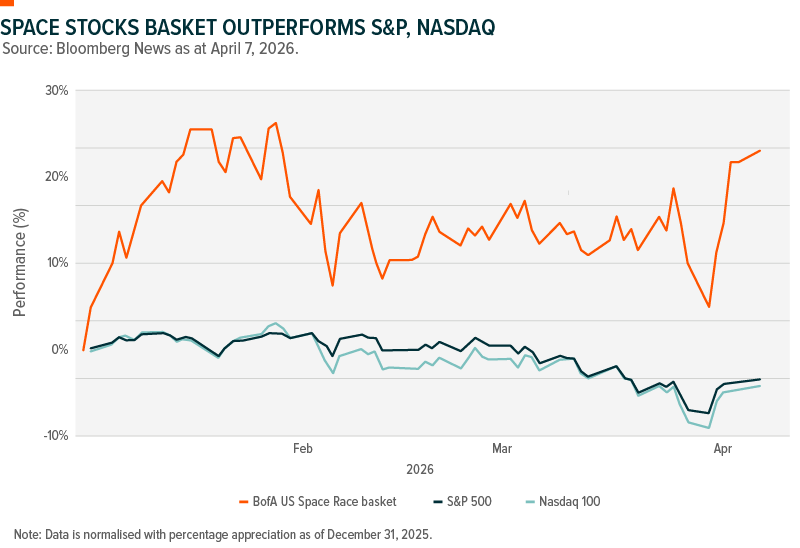
Investors are also noticing the burgeoning space industry. A basket of space-related U.S. stocks has climbed over 20% as at April 7, 2026, compared to a 3.4% decline in the S&P 500 Index and a 4.2% decline in the Nasdaq 100.
Attention in early 2026 has turned to one space company, on news of a potential stock market debut. Since its foundation in 2002, SpaceX has grown into an aerospace company that receives billions of dollars in U.S. government contracts.
In addition to its rocket launch business, which was the first private company to supply the International Space Station, SpaceX also operates satellite-based internet broadband service Starlink.
Why ORBX?
The Global X Space Tech Index ETF (ORBX) seeks to replicate, to the extent possible and net of expenses, the performance of an index that tracks companies driving the growth and commercialization of the global space economy, including space technologies and components, launch and orbital services, space exploration and tourism, and satellite-enabled communications and data services (currently, the Global X Space Tech Index).

“The high-profile IPO candidates on the horizon and the successful Artemis II mission are powerful reminders that the space economy is entering a more commercial, more visible and more investable phase,” says Chris McHaney, Executive Vice President, Investment Management & Strategy at Global X.
“Space innovation is increasingly tied to real-world infrastructure, including global broadband, secure communications, Earth observation, launch services and advanced components. ORBX gives Canadian investors a targeted way to access the public companies, enabling that growth across the global space value chain.”
- Trillion-Dollar Opportunity in Orbit
Space has shifted from a government endeavour to a commercial growth story. Launch costs have fallen roughly 20x in the past decade,10 and private companies now account for about 70% of all orbital launches.11 With the global space market on track to surpass $1 trillion by 2034,12 the investment opportunity is here. - A New Growth Story Is Taking Off
Satellites are powering the next wave of connectivity. About 15,000 orbit Earth today.13 By 2030, that number could reach 100,000 as companies race to deliver broadband internet, GPS, Earth imaging, and communications from space.14 As these networks scale, they are generating steady, subscription-style revenue and creating a compelling growth opportunity for investors15. - One ETF, Full Access to the Space Value Chain
ORBX is built to capture the full space value chain, from rocket builders, launch systems and satellite operators to the components and data services powering them. Only companies earning at least 50% of their revenue from space tech qualify for inclusion, helping the fund stay focused on the theme.
ETF name | Currency | Unit Type | Ticker Symbol | Target Exposure | Exchange | Management Fee* |
| Global X Space Tech Index ETF | Canadian Dollar | Class A Units (unhedged) | ORBX | Global X Space Tech Index | TSX | 0.49% |
* Plus applicable sales tax
Tracking Space Firms: Global X Space Tech Index
Tracked by ORBX, the Global X Space Tech Index tracks the performance of companies driving growth and commercialization of the global space economy. Here’s how the index has performed since its inception:
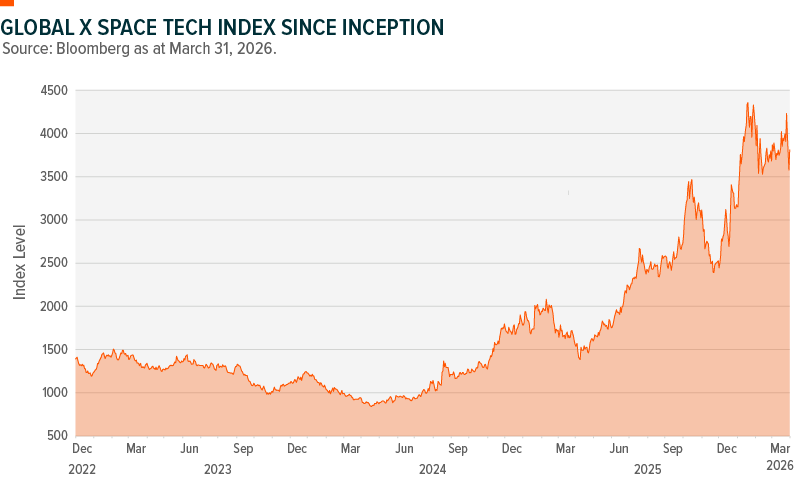
Note: The performance of the indices is provided for informational purposes only and does not represent the performance of the Fund. The Fund seeks to replicate the performance of the index, but several factors may result in deviations between the Fund’s performance and that of the index. These factors include, but are not limited to, tracking errors, the impact of fees and expenses, portfolio rebalancing, and differences in the timing of cash flows. Past performance of the index is not indicative of future results for the Fund. For more details on the Fund’s investment objectives, fees, and risks, please refer to the Fund’s prospectus.
And the most recent breakdown of sector and geographic allocation can be viewed below:
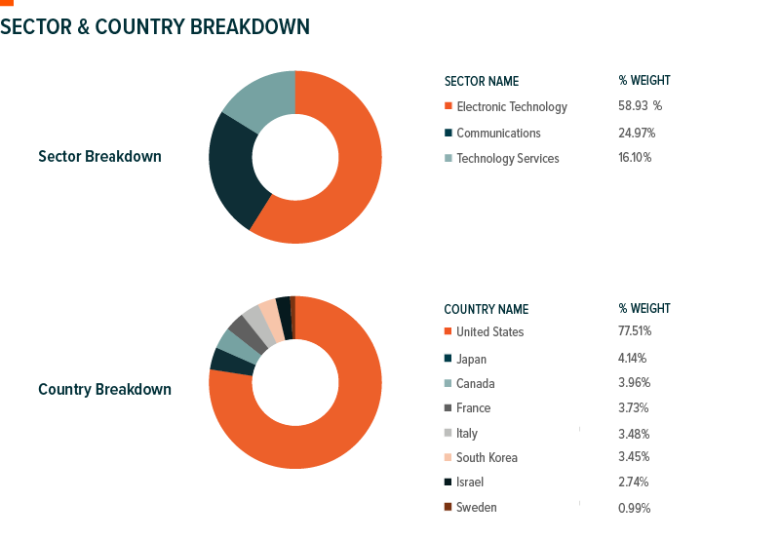
Source: Mirae Asset Indices as at March 31, 2026.
Participants in the Global Space Economy
Here is a brief look at some of the leading companies involved in the global space economy that are tracked by ORBX’s underlying index:


Rocket Lab
Founded by New Zealand-born Peter Beck in 2006, Rocket Lab Corporation provides launch services, spacecraft components, and orbital management. Known for its small-lift Electron rocket, the firm is developing the medium-lift Neutron rocket for orbital satellite networks.

BlackSky Technology
BlackSky Technology is a real-time, space-based intelligence company that delivers imagery, analytics, and high-frequency monitoring of the most critical and strategic locations, economic assets, and events in the world.

AST SpaceMobile
AST SpaceMobile is building a global cellular broadband network in space to operate directly with standard, unmodified mobile devices for nearly 6 billion mobile subscribers globally.

Planet Labs PBC
Founded in 2010 by three NASA scientists, Planet Labs provides satellite imagery and geospatial solutions to agriculture, forestry, intelligence, education and finance companies and government agencies around the world.
NOTE: The companies referenced are provided for illustrative purposes only to demonstrate sector exposure and are not intended as investment advice or recommendations to buy, sell, or hold any specific security.
Space has evolved from a government endeavour into a commercial economy — one that increasingly underpins connectivity, defence, and data services on the ground. Launch costs continue to fall, satellite networks continue to scale, and institutional investment in the sector continues to grow.
For investors looking to access this opportunity across the full space value chain, ORBX offers diversified exposure to the companies driving it.
Sources
1 SpaceX (March 2025), Falcon User’s Guide.
2 Space Stats as at February 27, 2026, Orbital launches per year.
3 Global X ETFs forecast with information derived from: Allied Market Research (January 2025), Space Launch Services Market Research; EMR (January 2026), Space Launch Services Market Size, Share and Forecast Trends – Growth Analysis and Outlook Report (2026-2035); Precedence Research. (May 28 2025), Space Launch Services Market Revenue to Attain US$57.94 Bn by 2033.
4 Scientific American (March 17 2026), SpaceX now has more than 10,000 Starlink satellites in orbit.
5 Novaspace (January 2026), The Space Economy Report; Satellite Industry Association. (May 2025), 2024 Global Satellite Industry Revenues.
6 Ibid.
7 Novaspace (January 2026), Global Space Spending Reaches $137B, Marking a Defence‑Led Era.
8 United States Space Force (April 2025), USSF defines path to space superiority in first Warfighting framework.
9 Wired (September 2025), Big Tech Dreams of Putting Data Centers in Space.
10 NASA (2020), The Recent Large Reduction in Space Launch Cost. NASA Technical Reports Server.
11 Payload Space (2025), 2025 Orbital Launch Attempts by Country.
12 Novaspace (January 2026), The Space Economy Report.
13 Jonathan’s Space Report (2026), Satellite Statistics: Satellite and Debris Population.
14 European Space Agency (2025), Around 100,000 Satellites Are Expected to Be in Orbit by 2030.
15 Satellite Industry Association (2025), Historic Number of Launches Powers Commercial Satellite Industry Growth.
Related ETFs
DISCLAIMERS
Commissions, management fees, and expenses all may be associated with an investment in products (the “Global X Funds”) managed by Global X Investments Canada Inc. The Global X Funds are not guaranteed, their values change frequently and past performance may not be repeated. Certain Global X Funds may have exposure to leveraged investment techniques that magnify gains and losses which may result in greater volatility in value and could be subject to aggressive investment risk and price volatility risk. Such risks are described in the prospectus. The prospectus contains important detailed information about the Global X Funds. Please read the relevant prospectus before investing.
Certain statements may constitute a forward-looking statement, including those identified by the expression “expect” and similar expressions (including grammatical variations thereof). The forward-looking statements are not historical facts but reflect the author’s current expectations regarding future results or events. These forward-looking statements are subject to a number of risks and uncertainties that could cause actual results or events to differ materially from current expectations. These and other factors should be considered carefully and readers should not place undue reliance on such forward-looking statements. These forward-looking statements are made as of the date hereof and the authors do not undertake to update any forward-looking statement that is contained herein, whether as a result of new information, future events or otherwise, unless required by applicable law.
This communication is intended for informational purposes only and does not constitute an offer to sell or the solicitation of an offer to purchase investment products (the “Global X Funds”) managed by Global X Investments Canada Inc. and is not, and should not be construed as, investment, tax, legal or accounting advice, and should not be relied upon in that regard. Individuals should seek the advice of professionals, as appropriate, regarding any particular investment. Investors should consult their professional advisors prior to implementing any changes to their investment strategies. These investments may not be suitable to the circumstances of an investor.
Mirae Asset Global Index Private Limited (an affiliate of the Manager) owns all rights to the trademark, name and intellectual property associated with any Underlying Index for which it is listed as the Index Provider in the Fund’s prospectus (in this disclaimer, the “Mirae Asset Indices”). No representation is made by Mirae Asset Global Index Private Limited that the Mirae Asset Indices are accurate or complete or that investment in a Mirae Asset Index or an ETF will be profitable or suitable for any person. The Mirae Asset Indices are administered and calculated by Mirae Asset Global Index Private Limited, and Mirae Asset Global Index Private Limited will have no liability for any error in the calculation of the Mirae Asset Indices. Mirae Asset Global Index Private Limited does not guarantee that the Mirae Asset Indices or their underlying methodology are accurate or complete.
All comments, opinions and views expressed are generally based on information available as of the date of publication and should not be considered as advice to purchase or to sell mentioned securities. Before making any investment decision, please consult your investment advisor or advisors.
For more information on Global X Investments Canada Inc. and its suite of ETFs, visit www.GlobalX.ca
Global X Investments Canada Inc. (“Global X”) is a wholly owned subsidiary of Mirae Asset Global Investments Co., Ltd. (“Mirae Asset”), the Korea-based asset management entity of Mirae Asset Financial Group. Global X is a corporation existing under the laws of Canada and is the manager, investment manager and trustee of the Global X Funds.
© 2026 Global X Investments Canada Inc. All Rights Reserved.
Published April 29, 2026.