Key Takeaways
- A major manufacturing wave: Between January 2025 and mid-March 2026, U.S. companies announced $1.4 trillion in new or expanded manufacturing facilities, primarily targeting semiconductors, electronics, and pharmaceuticals. This adds to more than $750 billion in investments announced under the Biden Administration, reflecting a sustained bipartisan drive to rebuild America’s industrial base and reduce critical supply chain vulnerabilities.
- The physical scale of re-industrialization: Building new manufacturing facilities demands enormous physical resources. A single semiconductor fab requires 600,000 cubic metres of concrete, 75,000 tonnes of steel reinforcement, and 6,000 construction workers. Power demand is equally significant: TSMC’s first Arizona fab alone requires 2.85GWh of electricity per day — equivalent to the needs of approximately 100,000 homes.
- Opportunities across the value chain: As planned manufacturing investments move through development, significant opportunities are expected for companies throughout the U.S. infrastructure value chain, including construction and engineering firms, raw material suppliers, equipment providers, and industrial transportation companies. The Global X U.S. Infrastructure Development Index ETF (PAVE) offers diversified exposure to these beneficiaries in a single trade.
The United States is in the middle of a generational buildout to lay the physical foundation for the next stage of its innovation economy. Today’s cycle rests on two core pillars: building Artificial Intelligence (AI) infrastructure that will enable the automation age and constructing next-generation manufacturing facilities that modernize the industrial base and reshore critical production. Together, these pillars represent a multi-trillion-dollar demand for the full U.S. infrastructure development value chain.
Between January 2025 and mid-March 2026, U.S. companies announced dozens of new or expanded manufacturing facilities totalling $1.4 trillion in potential investments (Source: Global X ETFs analysis as of March 17, 2026 from a variety of sources.) The majority target the reshoring of strategic industries — primarily semiconductors, electronics, and pharmaceuticals. These announced investments build on the more than $750 billion in U.S. manufacturing investments that were announced under the Biden Administration. (Source: The White House, as at November 26, 2024, The Biden-Harris Administration Has Catalyzed $1 Trillion in New U.S Private Sector Clean Energy, Semiconductor, and Other Advanced Manufacturing Investment.)
As these planned investments make their way through the development process, these trends are expected to benefit companies throughout the U.S. infrastructure development value chain, including construction and engineering services providers, raw material suppliers, equipment suppliers, and industrial transportation service providers.
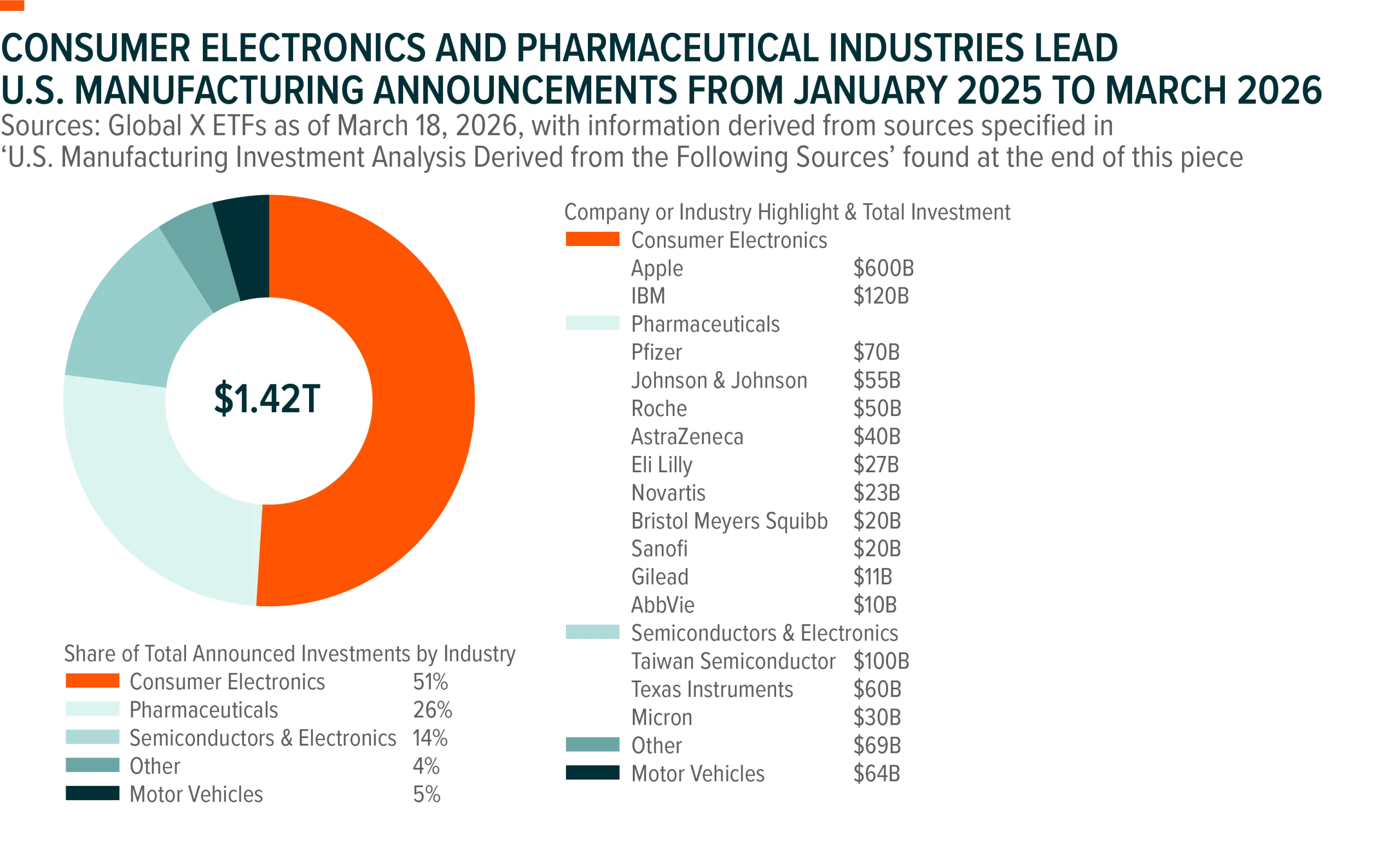
A $1.4 Trillion Industrial Pivot
The U.S. manufacturing landscape is at an inflection point, where producing goods in America has become more of a long-term strategic necessity. The implementation of ‘America First’ trade policies under the Trump Administration, including broad-based tariffs, has led to a flurry of planned investments by companies seeking to increase U.S. manufacturing capacity.
The consumer electronics industry leads U.S. manufacturing efforts, though investments in the segment are highly concentrated, with the majority coming from Apple and IBM. In February 2025, Apple announced plans to invest $500 billion over the next four years into new production capacity and supporting its suppliers throughout the country. (Source: (Apple as at February 24, 2025).
The pharmaceuticals industry accounts for nearly a quarter of all announced investments into U.S. manufacturing in 2025. In total, drugmakers announced plans to invest nearly $280 billion towards building out new production capacity. (Source: https://www.cnn.com/2025/08/02/business/drug-prices-trump-us-manufacturing) The largest commitments came from Johnson & Johnson, Roche, Eli Lilly, and Novartis. Johnson & Johnson alone plans to invest $55 billion into the United States over the next four years, including the construction of four new manufacturing facilities. (Source: Johnson & Johnson (2025, March 21), Johnson & Johnson Increases U.S. Investment to More than $55 Billion Over the Next Four Years.)
Semiconductor producers account for the third-largest share of announced investments, with nearly $135 billion in planned spending. (Source: https://www.newswire.ca/news-releases/semi-reports-global-semiconductor-equipment-billings-reached-135-billion-in-2025-up-15-year-on-year-837362926.html) This adds to the more than $300 billion in private investments towards U.S. chip manufacturing that were announced following the passage of the CHIPS Act.
Taiwan Semiconductor Manufacturing Company (TSMC) has the largest planned investment, encompassing six semiconductor fabrication plants (fabs), as well as packaging and research and development centres.
In March 2025, the company announced an additional $100 billion towards expanding U.S. operations, bringing its total commitment to $165 billion.
Manufacturing Construction Set to Accelerate
The investment announcements of 2025 are arriving against an already elevated baseline. Total private construction spending on manufacturing in the United States increased threefold — from $76.2 billion in January 2021 to nearly $230 billion in January 2025.
The enactment of the CHIPS Act and Inflation Reduction Act in August 2022 were key catalysts for new manufacturing construction in the years prior to the recent implementation of tariffs. However, many reshoring efforts across industries began even earlier in the decade, as a direct response to rising trade tensions and the supply chain disruptions caused by the COVID-19 pandemic.
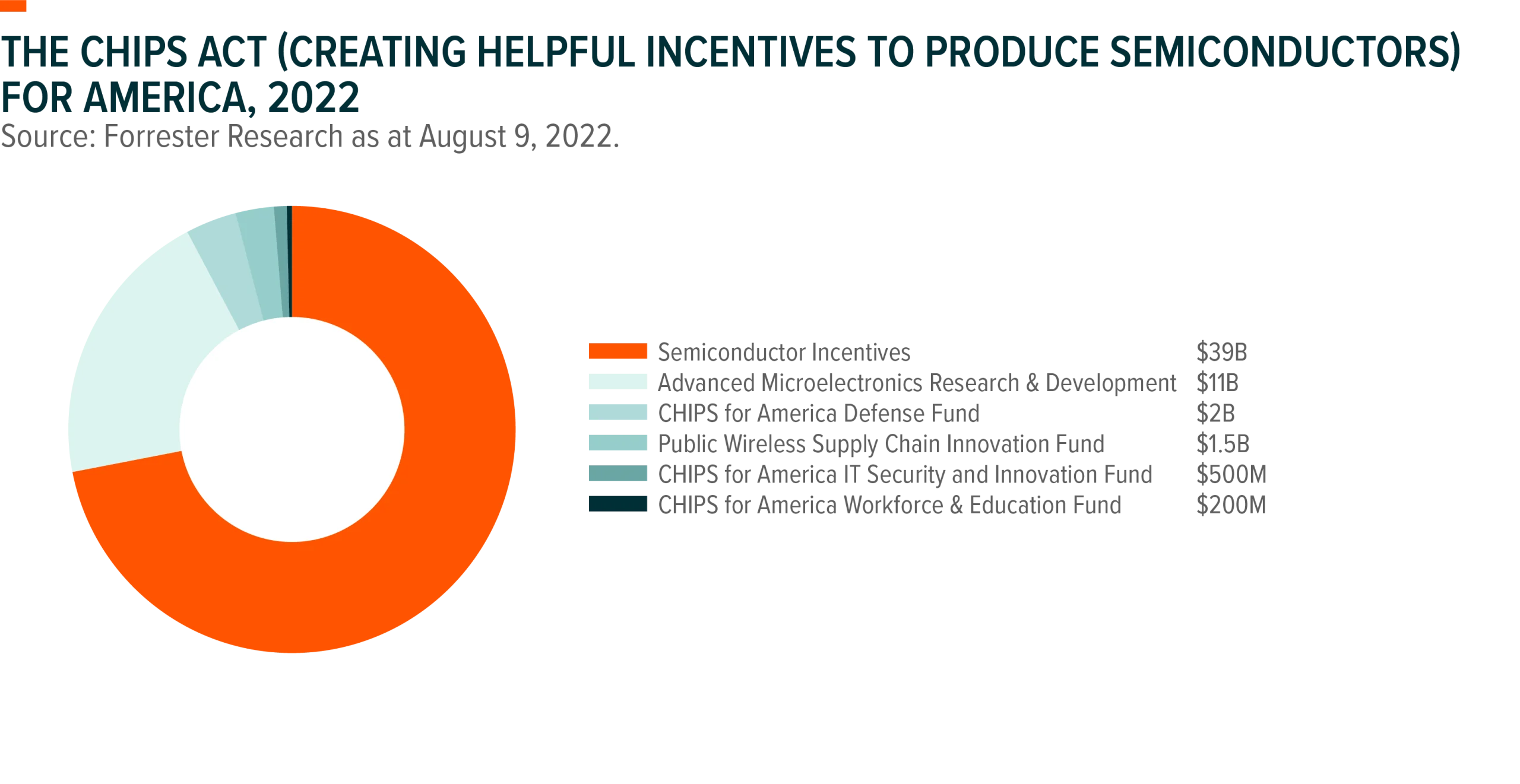
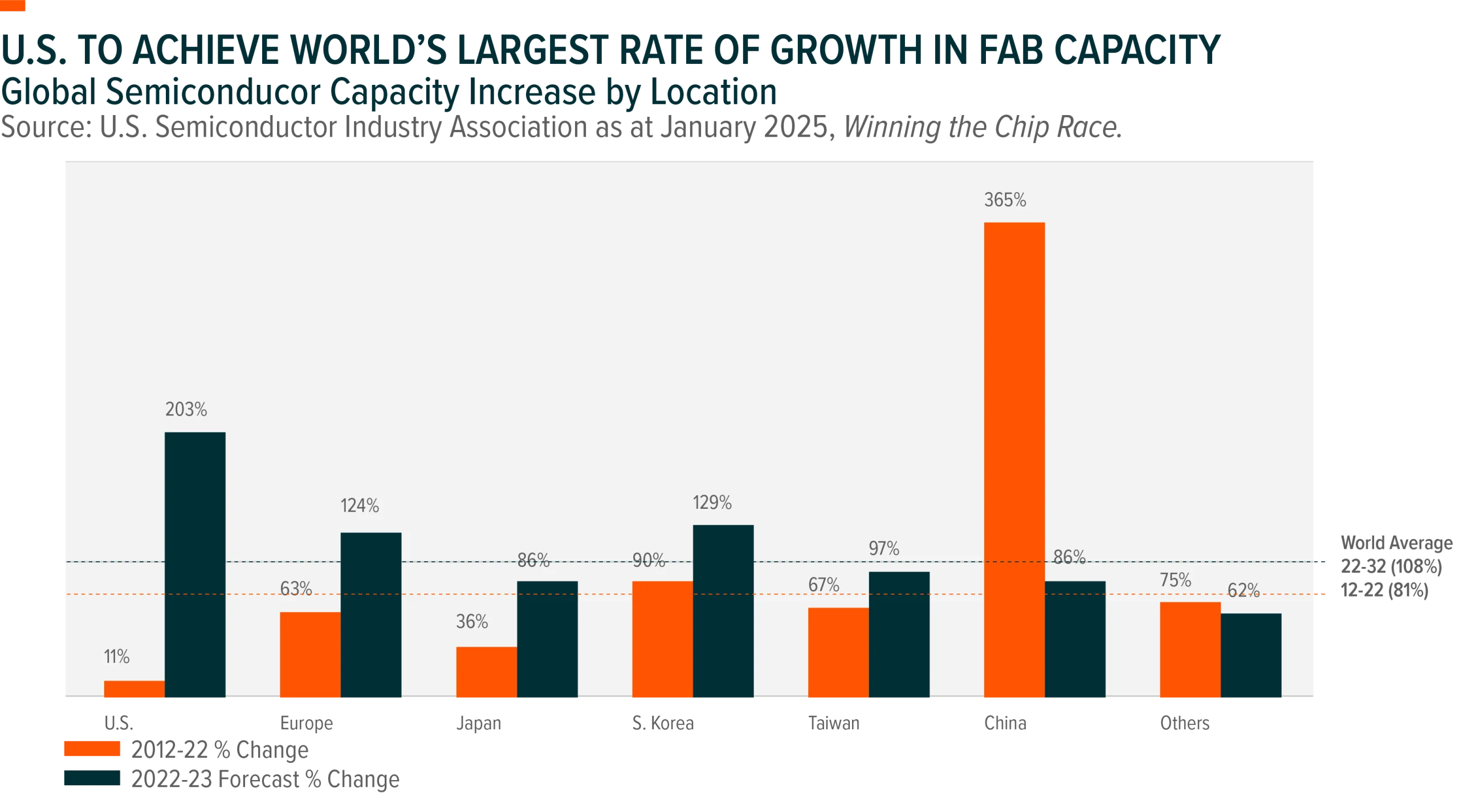
Looking forward, the breadth of announced investments, combined with rising geopolitical risk, reinforces the view that the reshoring of strategic sectors such as semiconductors and electronics may represent a longer-term structural trend rather than a short-term reaction.
The majority of the world’s AI chips today are manufactured in Taiwan, a key geopolitical chokepoint. Similar vulnerabilities exist across smartphones, critical drugs, medical devices, battery systems, and defence components. Rising labour costs in emerging markets such as China further erode the economic advantage of offshoring, reinforcing the shift toward domestic manufacturing.
The Scale of Infrastructure Required
Building out manufacturing facilities requires sizeable resources across construction materials, engineering, procurement, construction services, and labour. Intel, which is building three new semiconductor fabs in the United States, estimates that a single facility requires 600,000 cubic metres of concrete, 75,000 tonnes of steel reinforcement, 35,000 tonnes of structural steel, and 9 million metres of cable. Each factory also requires the removal of more than one million cubic metres of soil and rock, with an estimated 6,000 construction workers per project. Many planned facilities are located in remote areas, which can also require the buildout of roads and power infrastructure.
Investing in the Infrastructure Development Value Chain
For investors looking to participate in this long-term buildout, the Global X U.S. Infrastructure Development Index ETF (PAVE) offers targeted exposure to the companies positioned to benefit.
PAVE is the Canadian-listed version of the Global X U.S. Infrastructure Development ETF, which launched in the United States in 2017 and has grown to become one of the larger infrastructure-focused ETFs in North America. This Canadian launch leverages Mirae Asset Financial Group’s global ETF platform to bring this established strategy to investors in Canada.
This ETF seeks to replicate the performance of the Indxx U.S. Infrastructure Development Index, which tracks U.S.-listed companies that provide exposure to infrastructure development in the United States.
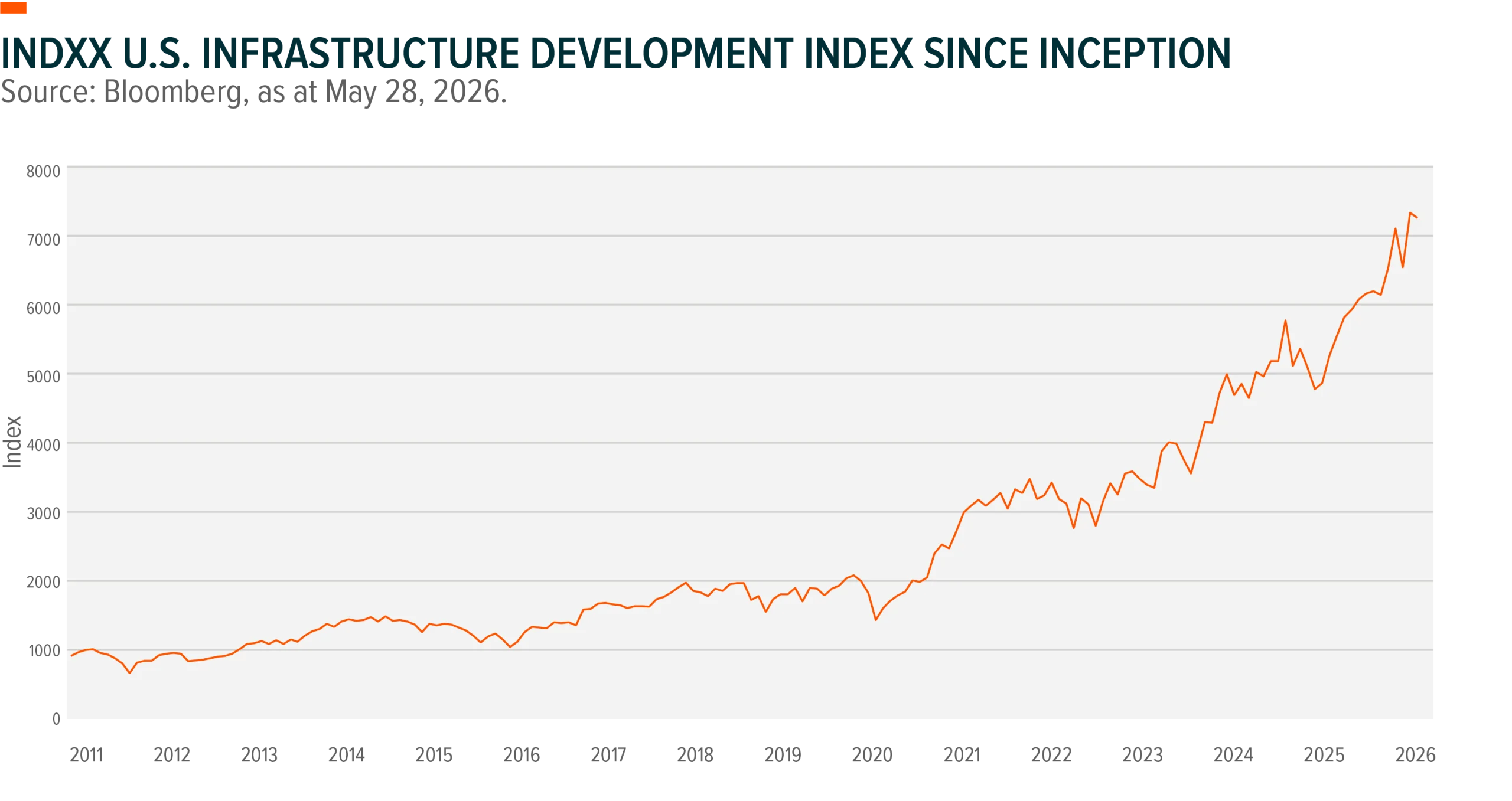
This includes companies involved in construction and engineering, the production of materials and composites, transportation of materials, and the manufacturing and distribution of heavy equipment.
Why PAVE?
Multi-Year Infrastructure Opportunity: PAVE gives investors access to a long-term U.S. infrastructure buildout supported by aging assets, major spending commitments, and a funding gap that points to years of continued investment.
Beyond Traditional Construction Exposure: The strategy reaches across the infrastructure ecosystem, including construction and engineering, raw materials, equipment, and industrial transportation, for a more complete way to access the theme.
Pure-Play Focus: The investment strategy uses revenue-based eligibility to emphasize infrastructure-linked companies, helping investors access businesses more closely tied to the U.S. infrastructure build cycle.
PAVE includes heavy equipment, transportation, and major engineering firms including:

Deere & Co
Founded in 1837, John Deere is known for manufacturing agricultural machinery, heavy equipment, and forestry machinery. Headquartered in Moline, Illinois the company include tractors, combine harvesters, and lawn care equipment.

CSX Corp
CSX Corporation provides rail-based transportation services including traditional rail service and the transport of intermodal containers and trailers. Its network encompasses about 20,000 miles of track in 26 states, the District of Columbia and the provinces of Ontario and Quebec. Nearly two-thirds of Americans live within CSX’s service territory.

Trane Technologies
Headquartered in Dublin, Ireland Trane Technologies delivers high‑efficiency HVAC (heating, ventilation, and air conditioning) systems, electrified transport refrigeration, digital and connected services, thermal management solutions and advanced controls that improve energy efficiency and environmental performance.
The United States is undertaking a generational buildout of AI infrastructure and manufacturing capacity, with $1.4 trillion in new facilities announced between January 2025 and mid-March 2026. The scale of construction required (for concrete, steel, power, and transportation infrastructure) creates substantial opportunities across the full U.S. infrastructure development value chain. PAVE offers Canadian investors diversified access to the companies with exposure to these infrastructure development trends.
References to the above securities are for illustrative and market commentary purposes only and should not be interpreted as a promotion, endorsement, or recommendation to trade said securities.
Related ETFs
DISCLAIMERS
Commissions, management fees and expenses all may be associated with an investment in products (the “Global X Funds”) managed by Global X Investments Canada Inc. The Global X Funds are not guaranteed, their values change frequently and past performance may not be repeated. The prospectus contains important detailed information about the Global X Funds. Please read the relevant prospectus before investing. Please read the relevant prospectus before investing.
Indxx is a service mark of Indxx, LLC (“Indxx”) and may be licensed for use for certain purposes by the Manager. PAVE.U is not sponsored, endorsed, sold or promoted by Indxx. Indxx makes no representation or warranty, express or implied, to the owners of PAVE.U or any member of the public regarding the advisability of investing in securities generally or in PAVE.U particularly. Indxx has no obligation to take the needs of the Manager or the Unitholders of PAVE.U into consideration in determining, composing or calculating the Indxx U.S. Infrastructure Development Index. Indxx is not responsible for and has not participated in the determination of the timing, amount or pricing of the Units to be issued or in the determination or calculation of the equation by which the Units are to be converted into cash. Indxx has no obligation or liability in connection with the administration, marketing or trading of PAVE.U.
Certain statements may constitute a forward-looking statement, including those identified by the expression “expect” and similar expressions (including grammatical variations thereof). The forward-looking statements are not historical facts but reflect the author’s current expectations regarding future results or events. These forward-looking statements are subject to a number of risks and uncertainties that could cause actual results or events to differ materially from current expectations. These and other factors should be considered carefully, and readers should not place undue reliance on such forward-looking statements. These forward-looking statements are made as of the date hereof and the authors do not undertake to update any forward-looking statement that is contained herein, whether as a result of new information, future events or otherwise, unless required by applicable law.
This communication is intended for informational purposes only and does not constitute an offer to sell or the solicitation of an offer to purchase investment products (the “Global X Funds”) managed by Global X Investments Canada Inc. and is not, and should not be construed as, investment, tax, legal or accounting advice, and should not be relied upon in that regard. Individuals should seek the advice of professionals, as appropriate, regarding any particular investment. Investors should consult their professional advisors prior to implementing any changes to their investment strategies. These investments may not be suitable to the circumstances of an investor.
All comments, opinions and views expressed are generally based on information available as of the date of publication and should not be considered as advice to purchase or to sell mentioned securities. Before making any investment decision, please consult your investment advisor or advisors.
Global X Investments Canada Inc. (“Global X”) is a wholly owned subsidiary of Mirae Asset Global Investments Co., Ltd. (“Mirae Asset”), the Korea-based asset management entity of Mirae Asset Financial Group. Global X is a corporation existing under the laws of Canada and is the manager, investment manager and trustee of the Global X Funds.
© 2026 Global X Investments Canada Inc. All Rights Reserved.
Published July 6, 2026