Key Takeaways
- The coordinated U.S.-Israel strikes on Iran in late February 2026 triggered an immediate market response, lifting crude, European natural gas, gold, the U.S. dollar, and Treasuries. For investors, the episode reinforced how quickly geopolitical escalation can reprice risk across commodities, currencies, and defensive assets.
- Previous conflicts can show how geopolitical realities can disrupt energy markets, weaken risk sentiment, and reshape the broader macro backdrop. Supply shocks and geopolitical uncertainty spilled into inflation, growth expectations, and market performance far beyond the immediate conflict zone.
- In today’s environment, rising global fragmentation has drawn attention to investing strategies that consider national security and strategic resilience, including energy, defence, commodities, shipping, and cybersecurity. For example, investors may look at energy producers in regions outside of conflict zones, such as Canada. The Global X Defence Tech Index ETF (SHLD) offers diversified exposure to defence modernization themes spanning AI, cyber, drones, surveillance, and advanced military systems.
Financial markets have repeatedly shown that conflicts do not stay contained to the battlefield. Across the Iranian revolution, the Iraq war, Russia’s invasion of Ukraine and now, the latest conflict in Iran, each episode has tested markets in different ways while reinforcing the connection between energy security, investor sentiment, and portfolio positioning.
2026: Strikes on Iran
Since the U.S. and Israel began coordinated military strikes on targets inside Iran that have resulted in regional escalation, markets have reacted quickly, with safe-haven assets rallying:
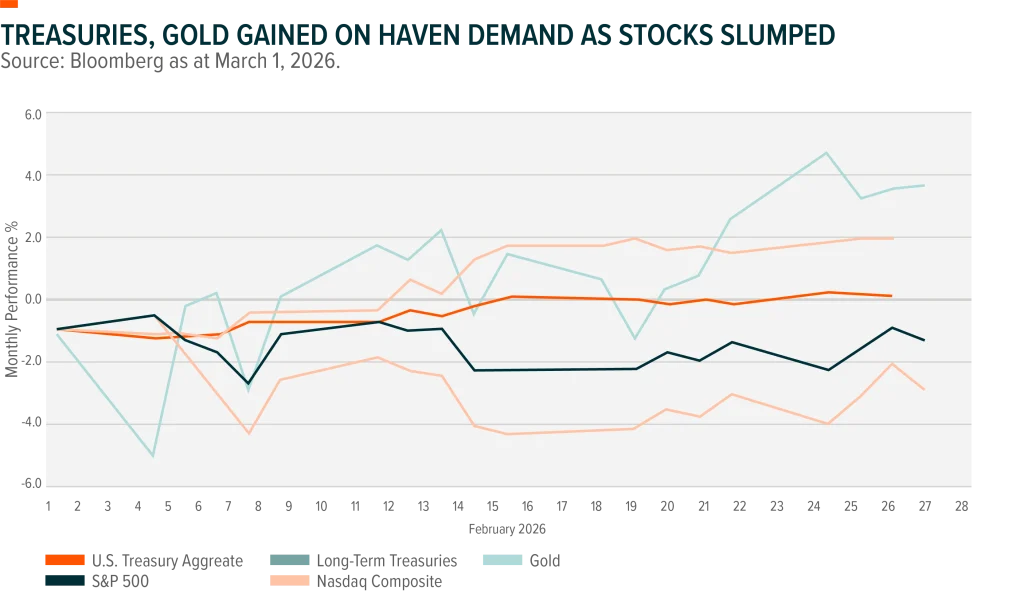
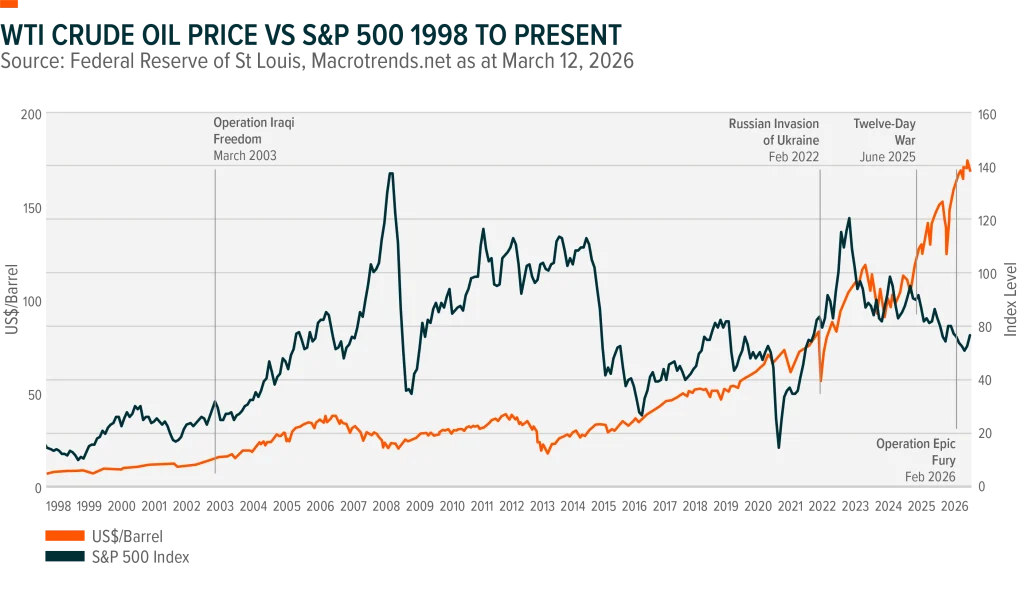
The price of West Texas Intermediate (WTI) crude surged to over US$100 a barrel, hitting levels not seen since 2022, driven by fears of shipping disruptions in the strategic Strait of Hormuz. On March X, prices fell, following President Trump’s remarks regarding the war being “pretty much complete”. Since then, prices have remained volatile, as the conflict continues.
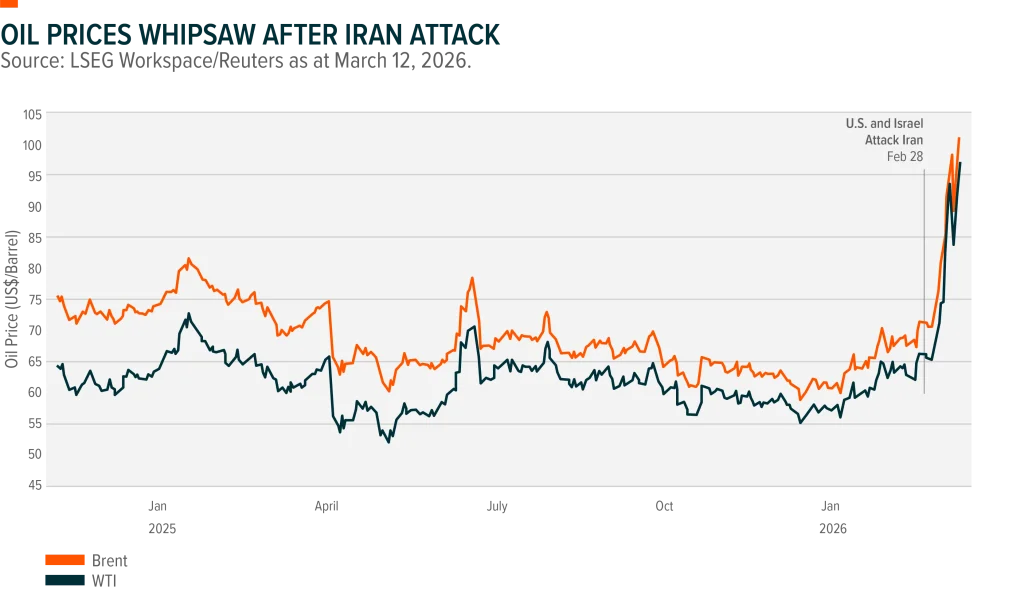
NOTE: Brent crude oil is considered the global benchmark for oil prices. WTI crude is the U.S. benchmark for crude oil.
European natural gas futures hit three-year highs after the attacks in Iran. Since the start of the year, implied volatility (measuring the cost of underlying options on futures contracts) for these contracts has risen fourfold.

“Oil derivatives traders remain positioned for renewed upside momentum even after crude prices recently pulled back,” says Global X ETF Strategist Raghav Mehta.
“The premium investors are paying for oil call options over puts is the highest in years. The oil market is experiencing extreme supply disruption, largely due to tanker traffic and exports being constrained through the Strait of Hormuz, which normally handles a major share of global oil flows.”
“The U.S. dollar, money markets, U.S. Treasury bills and gold are expected to be direct beneficiaries as risk repricing and safe haven flows hit markets. Precious metals act as economic, asymmetrical insurance while equities price the reconstruction narrative.”
“Defence and industrial metal equities are expected to enjoy a tactical bid on higher geopolitical spending expectations. We expect near-term inflows into defence stocks, gold, silver, bullion miners and industrial metals as events unfold,” the Global X ETF Strategist adds.
2022: Russia Invades Ukraine
Another major shock to markets came in early 2022 as Russia launched a full-scale invasion of Ukraine, turning a long-running regional conflict into Europe’s largest war in decades. From a market perspective, the invasion quickly became a major geopolitical shock, disrupting energy, commodities, trade flows, and investor sentiment.
The start of the war and the subsequent energy sanctions imposed on Russia resulted in a surge in crude oil prices. At their highest point, on March 7, 2022, WTI crude futures touched US$133.460 a barrel while Brent crude futures price reached US$139.130 a barrel, the highest price since July 2008. The beginning of the conflict also saw a 2.1% one-day drop in the S&P 500 Index, which saw a total drawdown of approximately 6.8%.
An overview of how key prices moved around the beginning of the war in Ukraine can be seen here:
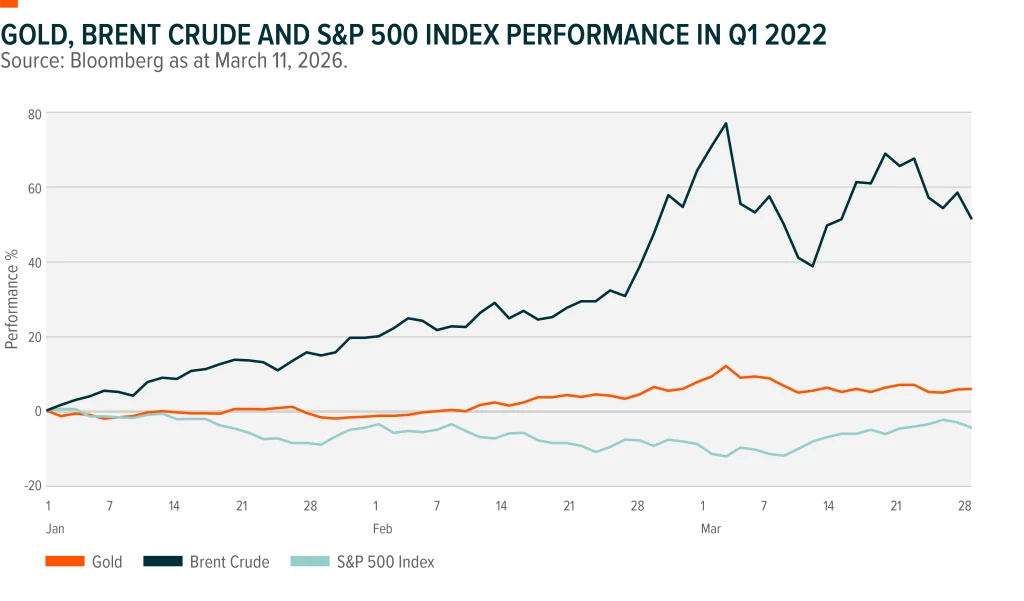
As with current events in Iran, at the time of publication, hostilities between Russia and Ukraine have continued for four years without resolution.
Since the start of the war, Russian oil exports have been steady despite sanctions as the nation re-routed supply via Asia. Russia was a major natural gas supplier prior to the war: Europe imported about 45% of its natural gas from Russia. Its share since the start of the war has fallen to below 10% as Europe committed to ending its fossil fuel reliance on Russia and has focused efforts on renewable energy. However, President Vladimir Putin has threatened to cut off Europe entirely from Russia’s gas pipeline.
“Geopolitical shocks reprice fear premiums and risk premiums much faster than macro fundamentals,” Global X’s Raghav Mehta adds.
“Near-term, the market pays for insurance: safe haven assets tend to act as that ‘insurance’ while equities rotate into reconstruction, defence, industrials and energy winners. Policy risk now matters as much as supply risks: if oil stays elevated and growth softens, central banks will be forced into a difficult ‘higher for longer’ narrative that tends to lift yields.”
1973’s Oil Shock: Energy Becomes a Weapon
The first major oil shock experienced by the West came in the early 1970s, when geopolitics and energy markets collided. What had been considered a reliable commodity resource suddenly became a strategic lever, with oil-producing nations using supply to exert political pressure.
Middle Eastern oil producers imposed an embargo to pressure the U.S. and its allies over their support for Israel during the Yom Kippur War. After Egypt and Syria launched an offensive to recapture territory lost in the 1967 Arab-Israeli war, the U.S. supplied Israel with military support. Arab members of the Organization of the Petroleum Exporting Countries (OPEC) viewed that move as hostile and responded by announcing oil embargoes against the West.
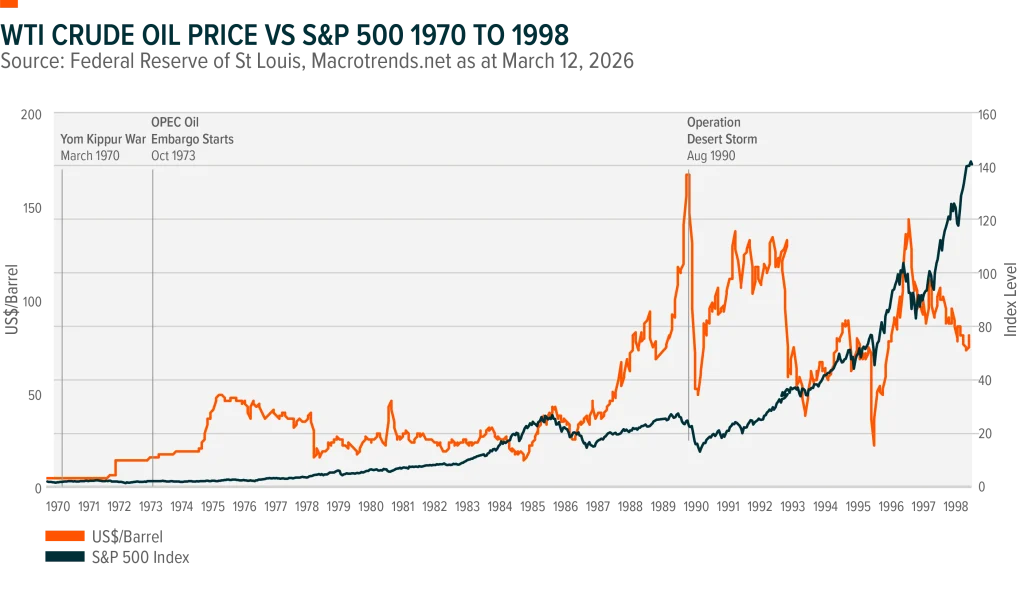
The restrictions turned oil into a geopolitical tool and highlighted the strategic importance of energy supply in times of conflict.
The consequences were immediate. Equities traded lower while the price of gold rose as the shock produced a combination that conventional economic models struggled to handle: low growth and surging inflation simultaneously.
Economists would eventually call this stagflation, and for investors, it remains one of the most difficult macro environments to navigate, offering limited protection from either equities or bonds. Could the current Iran conflict also herald stagflation’s return?
The result was a sharp reminder that energy security, foreign policy, and economic stability were deeply interconnected, with consequences that extended far beyond the Middle East.
Amidst Volatile Markets: Portfolio Possibilities?
Geopolitical conflicts and rising global tensions have sharpened investor focus on sectors that sit closest to national security and strategic supply chains, including energy, defence, commodities, shipping, and cybersecurity.
Disruptions to critical trade routes have also highlighted how closely energy security and shipping logistics are tied to economic resilience, market stability, and the smooth functioning of global trade.
“Investing in Canadian oil and gas leaders in this market environment can serve as a pragmatic hedge when supply shocks through the Strait of Hormuz push crude prices higher. Historically, during sustained supply shocks, energy equities have often outperformed the commodity over multi-month periods,” says Global X’s ETF strategist.
“Rather than relying on a single name, an equal-weight approach reduces single-name concentration and invests more systematically across the Canadian oil and gas sector, helping investors capture broader exposure to oil-driven rallies across producers, midstream, and services.”
The Global X Equal Weight Canadian Oil & Gas Index ETF (NRGY) offers direct equal-weight exposure to some of the largest and most liquid Canadian companies in the oil and gas industry. Canada is the world’s fourth-largest oil producer and the fifth-largest producer of natural gas.
“The situation in Iran also reinforces a structurally bullish backdrop for defence, as geopolitical fragmentation and regime risks harden political support for higher, longer-lasting defense budgets across economies.”
“Defence contractors, marine insurers and freight operators are the purest direct plays on higher geopolitical risks. We can expect selective strength in commodities and supply-chain beneficiaries when flows and trade lanes remain disrupted,” Mehta adds.
The Global X Defence Tech Index ETF (SHLD) offers a diversified way to express this conviction; packaging near-term, event-driven upside with a multi-year structural growth theme tied to global defense modernization. SHLD follows the Global X Defence Tech CAD Index, which is a diversified index of companies engaged in advancing military systems, technology, and hardware across Europe, North America, and Asia.
Taken together, the episodes shown above demonstrate that geopolitical conflict can reshape markets through energy disruption, inflation pressure, and shifting investor preferences. They also help explain growing interest in sectors tied to national security and strategic resilience, including defence, commodities, shipping, and cybersecurity, as investors look for ways to navigate their portfolios amid volatile markets.
Related ETFs
DISCLAIMERS
Commissions, management fees, and expenses all may be associated with an investment in products (the “Global X Funds”) managed by Global X Investments Canada Inc. The Global X Funds are not guaranteed, their values change frequently and past performance may not be repeated. Certain Global X Funds may have exposure to leveraged investment techniques that magnify gains and losses which may result in greater volatility in value and could be subject to aggressive investment risk and price volatility risk. Such risks are described in the prospectus. The prospectus contains important detailed information about the Global X Funds. Please read the relevant prospectus before investing.
Certain statements may constitute a forward-looking statement, including those identified by the expression “expect” and similar expressions (including grammatical variations thereof). The forward-looking statements are not historical facts but reflect the author’s current expectations regarding future results or events. These forward-looking statements are subject to a number of risks and uncertainties that could cause actual results or events to differ materially from current expectations. These and other factors should be considered carefully and readers should not place undue reliance on such forward-looking statements. These forward-looking statements are made as of the date hereof and the authors do not undertake to update any forward-looking statement that is contained herein, whether as a result of new information, future events or otherwise, unless required by applicable law.
This communication is intended for informational purposes only and does not constitute an offer to sell or the solicitation of an offer to purchase investment products (the “Global X Funds”) managed by Global X Investments Canada Inc. and is not, and should not be construed as, investment, tax, legal or accounting advice, and should not be relied upon in that regard. Individuals should seek the advice of professionals, as appropriate, regarding any particular investment. Investors should consult their professional advisors prior to implementing any changes to their investment strategies. These investments may not be suitable to the circumstances of an investor.
All comments, opinions and views expressed are generally based on information available as of the date of publication and should not be considered as advice to purchase or to sell mentioned securities. Before making any investment decision, please consult your investment advisor or advisors.
For more information on Global X Investments Canada Inc. and its suite of ETFs, visit www.GlobalX.ca
Global X Investments Canada Inc. (“Global X”) is a wholly owned subsidiary of Mirae Asset Global Investments Co., Ltd. (“Mirae Asset”), the Korea-based asset management entity of Mirae Asset Financial Group. Global X is a corporation existing under the laws of Canada and is the manager, investment manager and trustee of the Global X Funds.
© 2026 Global X Investments Canada Inc. All Rights Reserved.
Published March 20, 2026.