A strong earnings report. A successful product launch. An investment in new technology that starts to pay off. For investors following a company closely, these developments can strengthen the case for its future growth. But choosing the company is only part of the decision. How you invest in it matters, too.
Global X’s PowerStock ETFs give Canadian investors a way to seek greater participation in the growth potential of some of the world’s largest companies, including Alphabet, Amazon, Apple, NVIDIA, SpaceX and Tesla. Each ETF focuses on one company and targets approximately $133 of stock exposure for every $100 invested.
How PowerStocks work
Each ETF manages the borrowing that provides this additional exposure. Investors buy ETF units through their brokerage account without opening or managing a personal margin account. The additional exposure is built into the investment, making it straightforward to put more weight behind a researched view of a company.
For example, a 10% rise on $133 of stock exposure produces a gain of approximately $13.30, compared with $10 on a $100 direct investment. A 10% decline similarly produces a larger loss. Greater participation works in both directions.
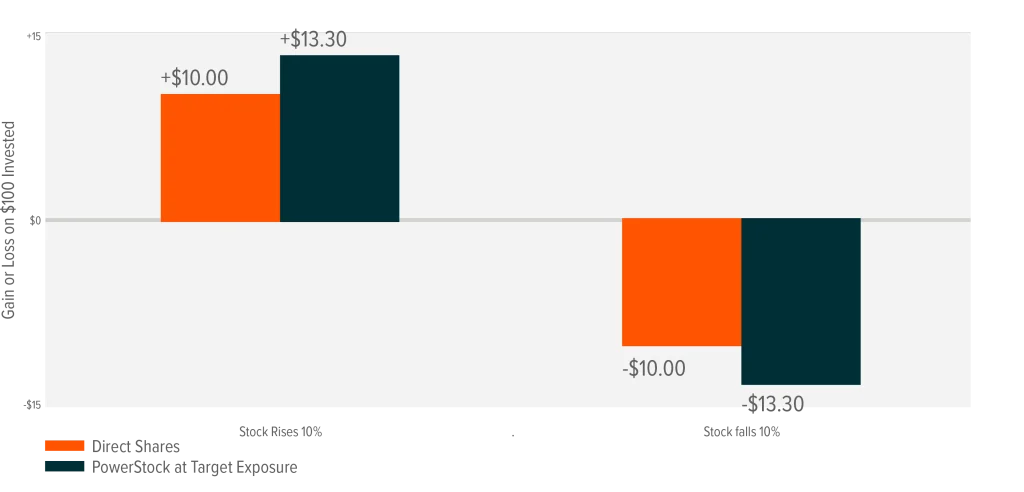
FOR ILLUSTRATIVE PURPOSES ONLY. Assumes constant exposure during one price move. Excludes fees, expenses, financing costs and currency effects. Not actual ETF performance; longer-period returns will not necessarily equal 1.33 times the stock’s return.
The Different Ways to Get Exposure to Single Stocks
Single-company products can offer very different investment experiences. Some prioritize income, others provide convenient access to listings on exchanges outside of Canada, and others amplify short-term stock movements with higher amounts of leverage.
Buying shares directly gives investors ownership in the company and dollar-for-dollar participation in its stock performance. PowerStocks provide exposure through an ETF, with borrowing managed within the fund to target approximately $133 of stock exposure for every $100 invested. Investors seeking greater participation can therefore obtain it without arranging their own margin borrowing.
Buying shares on margin allows investors to borrow through their brokerage to increase their investment in a company. Investors manage that borrowing themselves, pay interest and must maintain sufficient collateral. If their account falls below the broker’s requirements, they may face a margin call or the sale of securities. PowerStocks manage borrowing within the ETF, providing approximately 33% additional stock exposure without requiring investors to maintain a personal margin account.
Covered-call single-stock ETFs sell call options to collect premiums and support distributions. In exchange, they can give up some participation when the stock rises. Some also use leverage. PowerStocks do not use covered calls or seek to generate income, as their objective is long-term capital appreciation.
Canadian Depositary Receipts, or CDRs, provide exposure to foreign shares through Canadian-dollar-traded securities, typically with built-in currency hedging. Conventional CDRs provide unleveraged exposure. PowerStocks combine Canadian-dollar trading and currency hedging with approximately 33% additional stock exposure.
Higher-leverage single-stock ETFs commonly target two or three times a stock’s daily return. These products generally serve active, short-term strategies and are not generally intended for longer-term buy-and-hold investing. These products generally serve active, short-term strategies and are not meant to be hold for longer than a single day. PowerStocks use a lower leverage target and do not reset leverage daily, consistent with their long-term capital appreciation objective.
| Structure | Primary focus | Key consideration |
| Company Stock | Direct Exposure | Unleveraged stock exposure; no fund-level management fee; trading and other costs may apply |
| Company Stock (Margin) | Greater Exposure | Leveraged stock exposure; greater risk and costs |
| Conventional CDR | Canadian-dollar access | Unleveraged stock exposure; hedging costs |
| Covered-call single-stock ETF | Income | Option premiums can come at the expense of upside |
| PowerStock ETF | Long-term capital appreciation | Approximately 1.33x exposure; gains and losses amplified |
| Higher-leverage daily-reset ETF | Short-term tactical exposure | Typically 2x–3x daily; cumulative results are path dependent |
Registered account eligible
Investors generally cannot use conventional margin borrowing within a TFSA, RRSP or FHSA. PowerStock ETFs provide access to leveraged stock exposure within these account, subject to applicable tax rules, because the borrowing takes place inside the fund, rather than in the investor’s account. Investors can purchase eligible ETF units using available cash while the fund manages additional exposure.
Potential PowerStock ETF Portfolio Strategy
An investor can put the same amount of money to work and obtain greater company exposure, or invest less to obtain a chosen level of exposure. The choice starts with how much of the company they want in their portfolio, rather than simply how much cash they want to invest.
With $1,000 available, a $1,000 PowerStock investment targets approximately $1,330 of stock exposure. Alternatively, roughly $752 invested would target $1,000 of exposure, leaving about $248 available for cash reserves or other investments. Using less capital does not make the company exposure itself less risky.
The first approach gives investors greater participation in a company’s potential growth with the same initial investment. The second leaves more money available for other portfolio needs, such as cash reserves, fixed income or investments in other companies.
Both start with the same question: how much exposure do you want to this business? Consider any holdings you already have through other funds, and remember that using less capital does not reduce the risk of the underlying company exposure.
FOR ILLUSTRATIVE PURPOSES ONLY
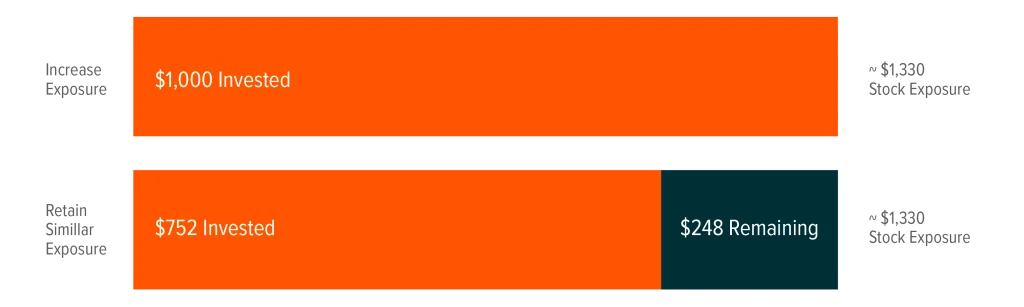
Illustrative capital allocation at 1.33x target exposure. Dollar amounts rounded; costs excluded. The second example provides $1,000.16 of exposure before rounding.
The first approach gives investors greater participation in a company’s potential growth with the same initial investment. The second leaves more money available for other portfolio needs, such as cash reserves, fixed income or investments in other companies.
Both start with the same question: how much exposure do you want to this business? Consider any holdings you already have through other funds, and remember that using less capital does not reduce the risk of the underlying company exposure.
Beyond the earnings headline
Quarterly results provide an opportunity to revisit an investment thesis. Revenue and profit matter, but so do management’s outlook, spending plans and progress in developing new businesses. A company can report growth and still see its shares fall if investors expected more.
For Alphabet and Amazon, investors might examine cloud demand and whether spending on artificial intelligence is translating into revenue. For NVIDIA, demand for computing platforms, customer spending plans and profitability as products evolve are useful areas to research.
At Apple, device demand and services revenue can help investors assess its customer ecosystem. For Tesla, vehicle margins, energy storage and progress in autonomy offer different perspectives on the business. At SpaceX, investors may focus on Starlink subscriber growth, launch activity and the spending required to pursue longer-term ambitions.
These are questions to investigate, rather than predictions of what will move each stock. What matters is how the results compare with expectations and what they suggest about future earnings. Business quality, valuation and the price already paid for anticipated growth all deserve attention.
Upcoming earnings dates
The following dates relate to the underlying companies’ earnings announcements, rather than the ETFs themselves. Use the calendar to plan research and follow developments that could affect each investment.
| Company | PowerStock ticker | Next earnings date | Status |
| Alphabet | GOOP | October 28, 2026 | Confirmed [3] |
| Amazon | AMZP | October 29, 2026 | Estimated [4] |
| Apple | AAPP | October 29, 2026 | Estimated [5] |
| NVIDIA | NVDP | November 18, 2026 | Estimated [6] |
| SpaceX | SPCP | N/A | Not verified |
| Tesla | TSLP | October 21, 2026 | Confirmed [7] |
Calendar checked October 8, 2026. Dates may change. Estimated dates are third-party projections and have not been verified as company-announced.
Built for Canadian portfolios
PowerStocks trade in Canadian dollars and hedge foreign currency exposure to help keep returns focused on company performance. They are eligible for TFSAs, RRSPs and FHSAs, with an annual management fee of 0.15%, plus borrowing costs and other expenses.
They can complement a diversified portfolio when an investor wants greater exposure to a particular company. Position size matters: that company may already appear in index funds or other holdings. Each PowerStock ETF is concentrated in one company, and leverage magnifies gains and losses.
For investors who have researched a business and want greater participation in its long-term potential, PowerStocks provide another way to put that conviction to work.
Explore the lineup at globalx.ca/powerstock-etfs.
Sources
Commissions, management fees, and expenses all may be associated with an investment in products (the “Global X Funds”) managed by Global X Investments Canada Inc. The Global X Funds are not guaranteed, their values change frequently and past performance may not be repeated. Certain Global X Funds may have exposure to leveraged investment techniques that magnify gains and losses which may result in greater volatility in value and could be subject to aggressive investment risk and price volatility risk. Such risks are described in the prospectus. The prospectus contains important detailed information about the Global X Funds. Please read the relevant prospectus before investing.
The Global X PowerStock ETFs (the “ETFs”) are open-end mutual funds established under the laws of Ontario. Each of the ETFs is an “alternative mutual fund” within the meaning of NI 81-102, and accordingly, is permitted to use strategies generally prohibited by conventional mutual funds, such as, the ability to invest more than 10% of the ETF’s net asset value in securities of a single issuer, the ability to borrow cash, to employ leverage, and to make substantial investments in other alternative mutual funds. While these strategies will only be used in accordance with the applicable investment objectives and strategies of the ETFs, during certain market conditions they may accelerate the risk that an investment in Units of such ETFs decreases in value.
Each ETF is concentrated and is non-diversified, meaning it is only exposed to a single Specified Public Issuer (as defined in the ETF’s prospectus) compared to a typical exchange-traded fund, which has a diversified portfolio. As a result, the ETFs’ assets are more susceptible to the impact of any specific company event or any single economic, technological, or regulatory event compared to a diversified portfolio.
Certain statements may constitute a forward-looking statement, including those identified by the expression “expect” and similar expressions (including grammatical variations thereof). The forward-looking statements are not historical facts but reflect the author’s current expectations regarding future results or events. These forward-looking statements are subject to a number of risks and uncertainties that could cause actual results or events to differ materially from current expectations. These and other factors should be considered carefully and readers should not place undue reliance on such forward-looking statements. These forward-looking statements are made as of the date hereof, and the authors do not undertake to update any forward-looking statement that is contained herein, whether as a result of new information, future events or otherwise, unless required by applicable law.
This communication is intended for informational purposes only and does not constitute an offer to sell or the solicitation of an offer to purchase investment products (the “Global X Funds”) managed by Global X Investments Canada Inc. and is not, and should not be construed as, investment, tax, legal or accounting advice, and should not be relied upon in that regard. Individuals should seek the advice of professionals, as appropriate, regarding any particular investment. Investors should consult their professional advisors prior to implementing any changes to their investment strategies. These investments may not be suitable to the circumstances of an investor.
All comments, opinions and views expressed are generally based on information available as of the date of publication and should not be considered as advice to purchase or to sell mentioned securities. Before making any investment decision, please consult your investment advisor or advisors.
Global X Investments Canada Inc. (“Global X”) is a wholly owned subsidiary of Mirae Asset Global Investments Co., Ltd. (“Mirae Asset”), the Korea-based asset management entity of Mirae Asset Financial Group. Global X is a corporation existing under the laws of Canada and is the manager, investment manager and trustee of the Global X Funds.
© 2026 Global X Investments Canada Inc. All Rights Reserved.
Published October 14, 2026