South Korea’s two memory-chip leaders dominate its stock market. The rest of the index spans an industrial economy built around defence, shipbuilding, batteries, autos and advanced materials.
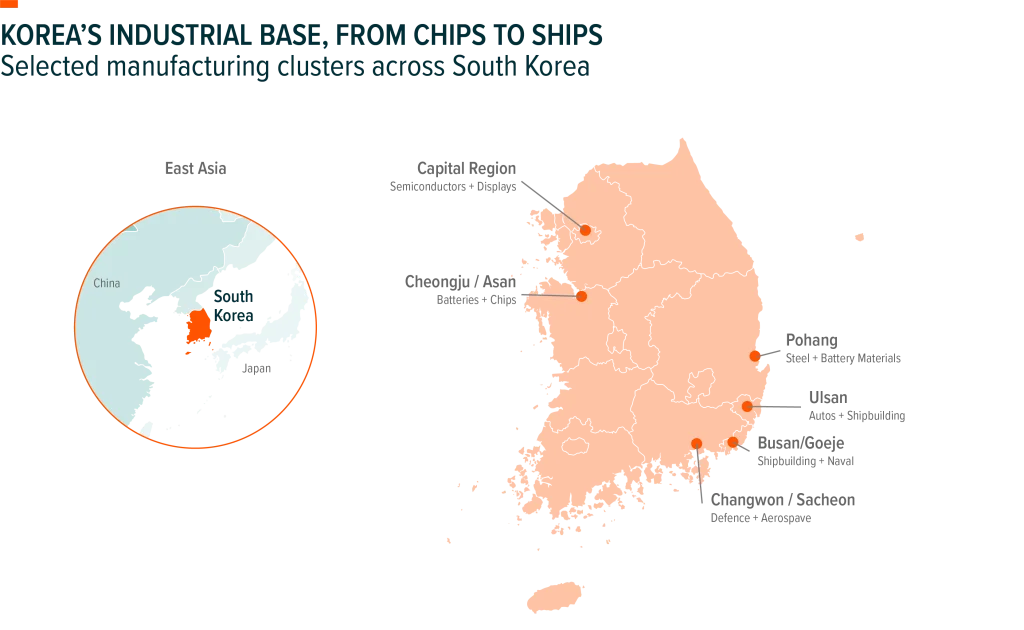
Source: Invest KOREA; Samsung Semiconductor; company materials. Selected clusters; locations are approximate. As at September 1, 2026.
Key Takeaways
- A different part of the AI supply chain: U.S. technology portfolios lean toward chip designers, cloud platforms and software. Korea’s strength is manufacturing the memory those systems need at scale.
- Capacity that already exists: Higher budgets cannot create shipyards, tank lines or battery plants overnight. Korea has the factories, engineers and export experience to supply allied markets now.
- A possible shareholder catalyst: Korea’s Value-up Program and changes to its Commercial Act are intended to encourage improvements in capital allocation, governance and shareholder returns.
- Portfolio concentration: Samsung Electronics and SK hynix currently account for well over half of a public KOSPI 200-tracking proxy. Semiconductor cycles, currency, trade and geopolitical risks all affect the index.
Introducing KORX
The Global X Korea KOSPI 200 Index ETF (KORX) offers Canadian investors a way to invest in this story without trying to pick individual winners. The ETF is designed to track the KOSPI 200, which brings together 200 of the largest companies listed on the Korea Exchange.
Today’s portfolio is led by Samsung Electronics and SK hynix. It also includes banks, automakers, defence contractors, shipbuilders, battery makers, materials businesses and other companies tied to Korea’s economy.
Understanding Korea’s Economy
Korea is easy to reduce to a semiconductor trade. Samsung Electronics and SK hynix dominate the local market, and their fortunes matter enormously to the KOSPI 200. Follow the country’s export data – or trace its industrial centres from Pyeongtaek to Ulsan – and a broader picture emerges. Korea is one of the few advanced economies able to manufacture memory chips, cars, batteries, LNG carriers and modern defence equipment at global scale.
That industrial depth has been built over decades. Korea has developed the engineers, supplier networks, ports and production lines needed to make complex products in large volumes. Merchandise exports reached a record US$709.7 billion in 2025. Semiconductors led the way, while automobiles and ships also set or approached record levels.
What investors actually own in the KOSPI 200
The KOSPI 200 holds 200 companies selected for their size, liquidity and representation of Korea’s major industries. It is free-float adjusted and weighted by market capitalization, so its largest companies carry far more influence than the rest.
As of September 2, 2026, information technology made up 68.6% of a publicly available KOSPI 200-tracking portfolio. Samsung Electronics and SK hynix alone represented 59.8%. There is no getting around that concentration: the index gives investors broad access to corporate Korea, but its near-term direction is still closely tied to memory pricing and global spending on AI infrastructure.
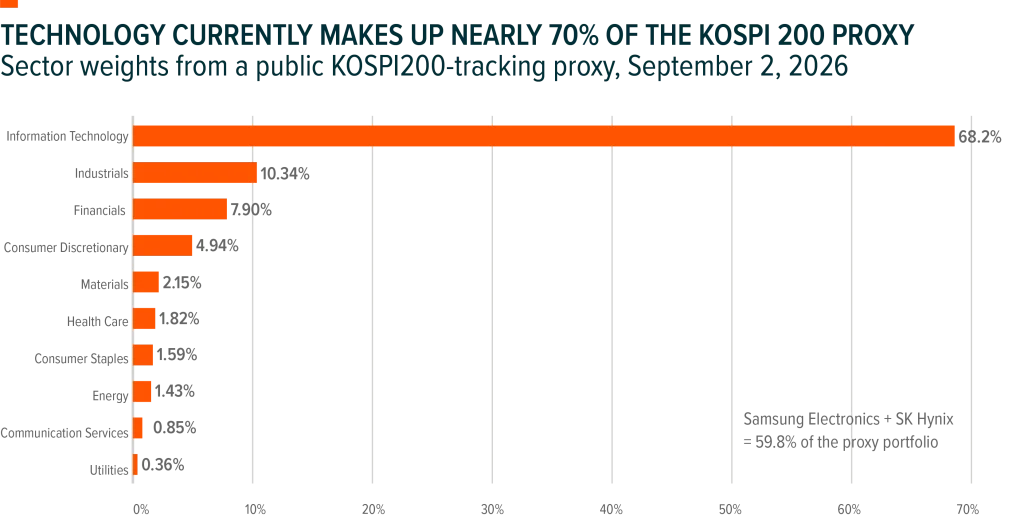
Source: RISE ETF, RISE 200 portfolio and sector data, September 2, 2026. The portfolio is used as a public proxy for the KOSPI 200; index and fund weights may differ.
AI and the demand for memory
Graphic processing units (GPUs) may get most of the attention, but AI systems are just as dependent on memory. High-bandwidth memory, or HBM, sits close to AI accelerators and moves data fast enough to keep them working efficiently. Dynamic random access memory (DRAM) supplies working memory, while NAND flash handles longer-term storage. As AI models grow and inference spreads, demand reaches across all three categories.
For investors, this is a different slice of the AI opportunity than they typically receive through U.S.-heavy technology portfolios. U.S. markets are well represented by chip designers, cloud platforms and software companies. Korea’s two largest companies sit in the physical supply chain, manufacturing the memory used by AI accelerators and data centres.
This position reflects years of investment. Samsung Electronics and SK hynix built the manufacturing scale and technical expertise that now place them at the centre of the AI supply chain. Together, they held 73% of the global DRAM market and 51% of NAND flash in 2022. By the third quarter of 2025, their combined HBM share had reached 88%, according to Counterpoint Research data reported by Reuters. Korean semiconductor exports rose 22.2% in 2025 to a record US$173.4 billion – nearly one-quarter of the country’s merchandise exports.
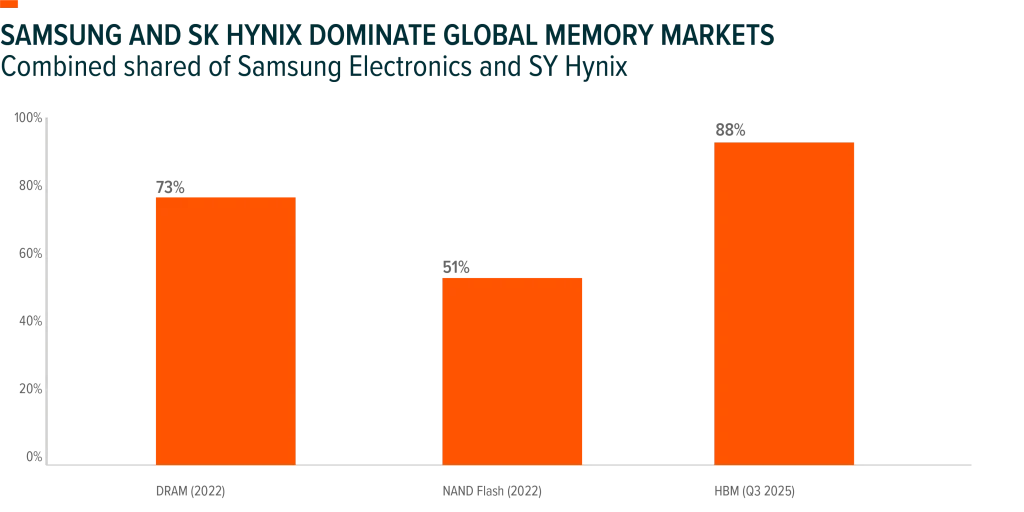
Source: U.S. International Trade Administration, based on TrendForce data for 2022; Reuters, based on Counterpoint Research data for Q3 2025.
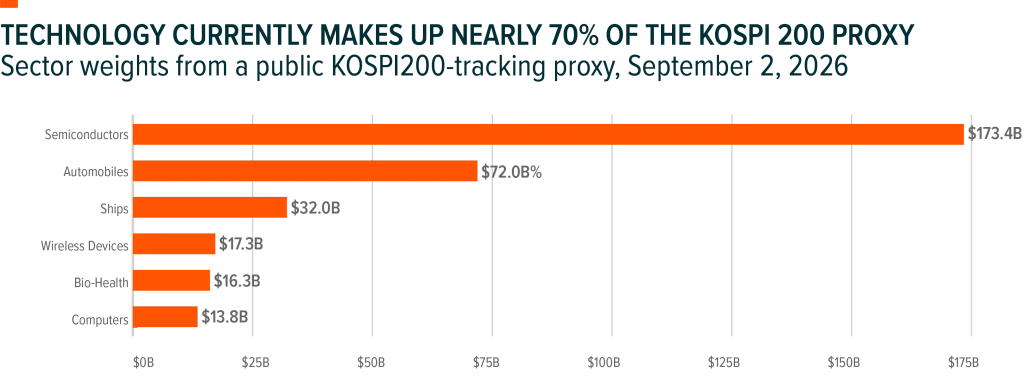
Source: Korea Ministry of Trade, Industry and Resources, January 2, 2026. Selected categories; values do not sum to total exports.
Korea’s industrial advantage was built over decades
Friendshoring is sometimes presented as though Western economies can simply swap out China. In practice, money and technology do not create factories, skilled workers or supplier networks overnight. Korea already has much of this capacity, along with engineering expertise, export experience and production systems that can work with allied-country supply chains.
Defence: built to produce, now built to export
Korea’s security environment gave it a reason to keep producing conventional military equipment even as many Western countries allowed their capacity to shrink after the Cold War. Today, Korean companies export K9 self-propelled howitzers, K2 tanks, FA-50 aircraft, missile systems and naval vessels. Hanwha Aerospace, Hyundai Rotem and Korea Aerospace Industries are among the KOSPI 200 companies tied to this business.
Defence export orders climbed from US$7.25 billion in 2021 to a record US$17.3 billion in 2022 and have remained well above the roughly US$3 billion annual range seen during much of the 2010s. The annual numbers will be uneven because a few large contracts can move the total dramatically. Poland shows why Korea’s existing capacity matters: the first 180 K2 tanks were delivered by November 2025, followed by a second order for another 180. That agreement combines near-term Korean production with 61 tanks to be assembled in Poland, supported by local maintenance infrastructure and technology transfer.
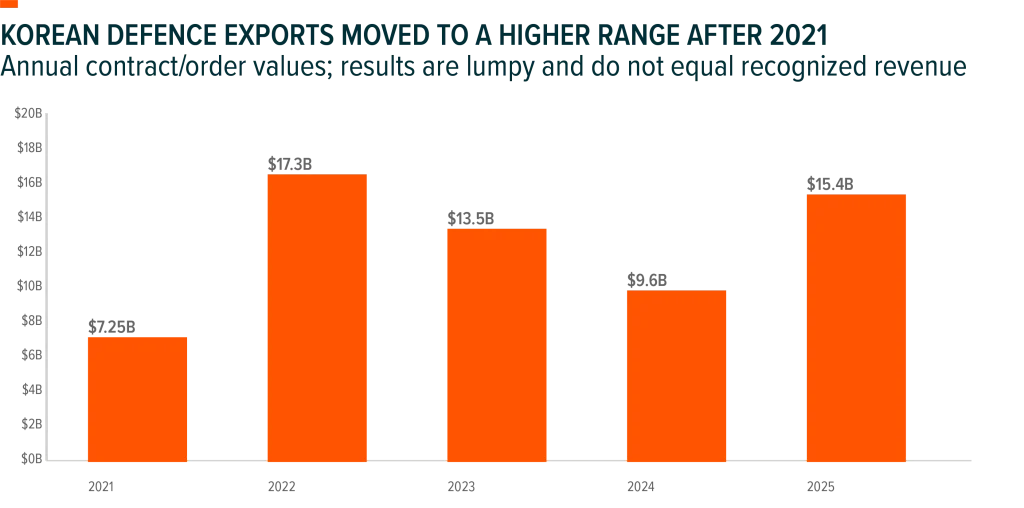
Source: Korea National Assembly Budget Office; Korea Defense Acquisition Program Administration; Yonhap News Agency. Annual contract/order values.
Shipbuilding: one of the few countries that can still build at scale
South Korea produced approximately 28% of global shipbuilding output by gross tonnage in 2024, second only to China. Korean yards are especially strong in more demanding vessels, including LNG carriers and ultra-large container ships. Hanwha Ocean and HD Hyundai give KOSPI 200 investors exposure to this ecosystem. As the United States and Europe confront limited shipbuilding capacity, Korean companies may also find opportunities in naval construction, maintenance and repair, shipyard investment and technology partnerships.
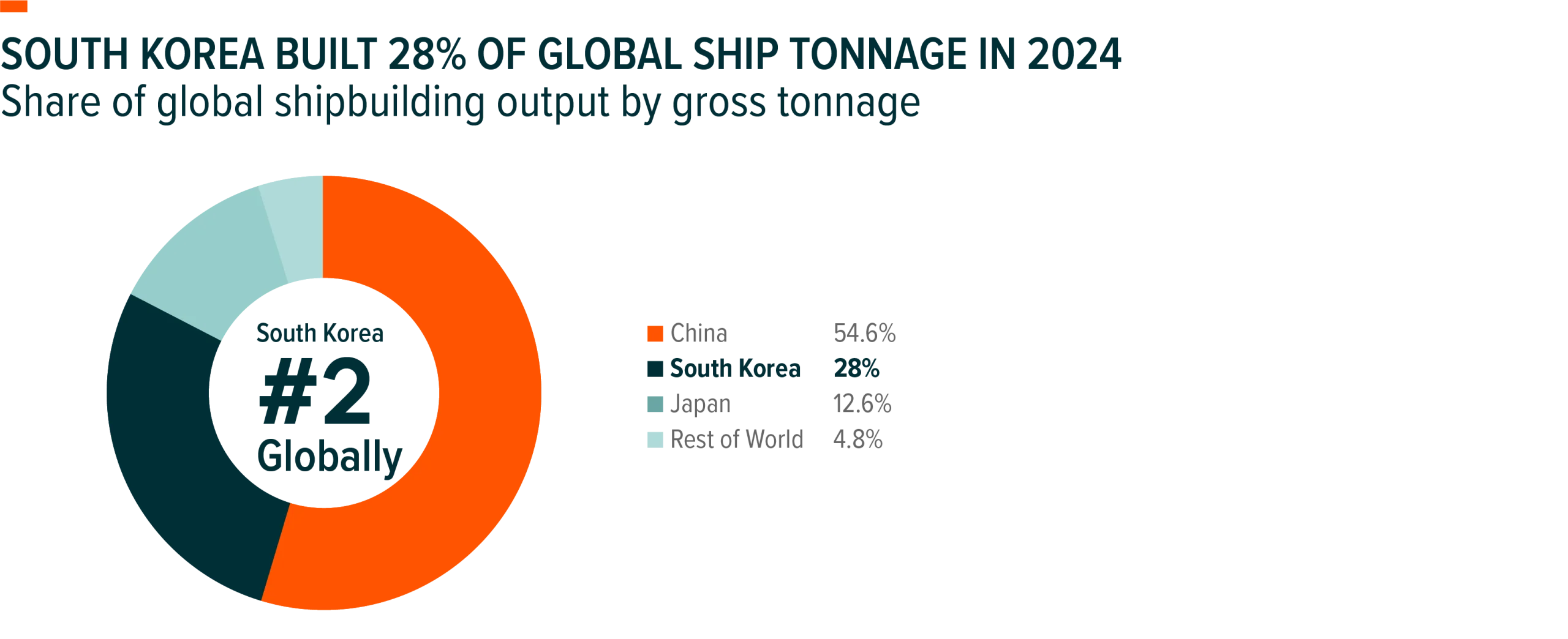
Source: UN Trade and Development, Review of Maritime Transport 2025.
Batteries, autos and materials round out the picture
Korea’s battery makers are under real pressure from Chinese competitors, and that should not be glossed over. LG Energy Solution, SK On and Samsung SDI supplied 36.3% of EV-battery usage outside China in 2025, but their combined share fell to 28.7% in the first four months of 2026. Even so, Korea remains home to one of the largest non-Chinese battery ecosystems. Their plants and joint ventures across North America and Europe give Korean companies a role as battery and energy-storage supply chains become more regional. Hyundai Motor, Kia, POSCO Holdings and LG Display extend the KOSPI 200’s reach into vehicles, steel and display panels as well.
Can Korea close the ‘Korea discount’?
Korean shares have long traded at lower valuations than many international peers. Investors often point to complex conglomerate structures, cross-shareholdings, inconsistent capital allocation and weak protections for minority shareholders. Korea’s Corporate Value-up Program, introduced in 2024, is an attempt to change that record by encouraging companies to publish plans for improving returns on equity, capital efficiency and shareholder payouts.
Participation has accelerated. By the end of August 2026, 756 listed companies had disclosed value-up plans, up from 92 at the end of 2024. The participating KOSPI companies represented 87.7% of main-board market capitalization. Amendments to Korea’s Commercial Act have also expanded directors’ duty of loyalty to shareholders and increased the required share of independent directors at listed companies.
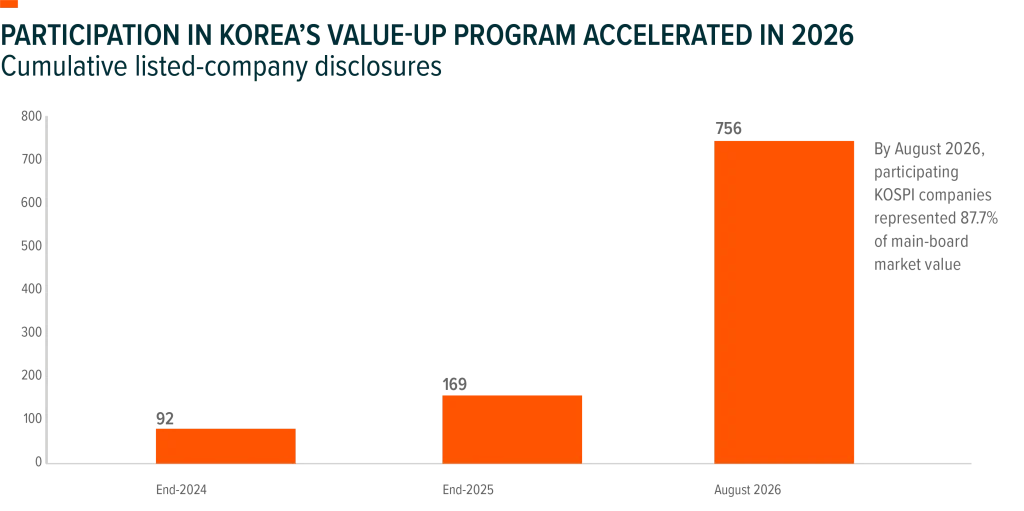
Source: Korea Exchange, August 2026 monthly Corporate Value-up update; Seoul Economic Daily, September 3, 2026.
Japan offers a useful comparison, although not a blueprint. Its modern reform effort began with stewardship and governance codes in 2014 and 2015, followed by the Tokyo Stock Exchange’s 2023 request for companies to focus on cost of capital and share price. Over time, more Japanese companies increased dividends and buybacks, reduced cross-shareholdings and addressed underperforming assets. Korea is earlier in the process and its chaebol structures create distinct challenges. Disclosing a plan is a start; a lasting re-rating will require companies to change how they allocate capital and treat minority shareholders.
KORX at a glance
| Fund | Global X Korea KOSPI 200 Index ETF |
| Tickers | KORX (Canadian-dollar units); KORX.U (U.S.-dollar units) |
| Underlying index | KOSPI 200 Index |
| Investment objective | Seeks to replicate, to the extent possible and net of expenses, the performance of an index comprised of major companies listed on the Korea Exchange (currently, the KOSPI 200 Index). |
| Management fee | 0.45% annually, plus applicable sales tax |
| Currency | No currency hedging is employed |
KORX reaches well beyond semiconductors, but its current weights still make it a concentrated, technology-sensitive allocation. This concentration and technology sensitivity are important risks to consider.
Risks to keep in view
Korea is not a low-risk market. The KOSPI 200 can be moved sharply by Samsung Electronics and SK hynix, memory-chip prices and swings in semiconductor spending. Competition from China, trade restrictions and changes in global AI investment can affect several Korean industries at once. Investors also take on Korean-won currency exposure, single-country and foreign-market risk, corporate-governance concerns and the geopolitical risks of the Korean peninsula.
AI-related demand is one factor drawing attention to Korea’s economy. Its export-ready industrial capacity may matter for much longer, while reform could determine how much of that strength reaches shareholders. KORX provides focused exposure to Korea’s economy through a Canadian-listed ETF.
DISCLAIMERS
Commissions, management fees and expenses all may be associated with an investment in products (the “Global X Funds”) managed by Global X Investments Canada Inc. The Global X Funds are not guaranteed, their values change frequently and past performance may not be repeated. The prospectus contains important detailed information about the Global X Funds. Please read the relevant prospectus before investing.
KOREA EXCHANGE (“KRX”) DOES NOT GUARANTEE THE ADEQUACY, ACCURACY, TIMELINESS AND/OR THE COMPLETENESS OF ANY INDICES DEVELOPED AND PRODUCED BY KRX (“THE KRX INDICES”) AND ANY DATA AND INFORMATION INCLUDED THEREIN, RELATED TO, OR DERIVED THEREFROM (THE “INDEX DATA”). THE KRX INDICES AND THE INDEX DATA ARE PROVIDED ON AN “AS IS” BASIS, AND ANY USE THEREOF IS AT THE USER’S OWN RISK. KRX SHALL HAVE NO LIABILITY WITH RESPECT TO THE ADEQUACY, ACCURACY, TIMELINESS AND/OR COMPLETENESS OF THE KRX INDICES OR THE INDEX DATA, INCLUDING ANY ERRORS, OMISSIONS, OR INTERRUPTIONS THEREIN. KRX DOES NOT GUARANTEE THE ADEQUACY, ACCURACY, TIMELINESS AND/OR THE COMPLETENESS OF THE KRX INDICES AND THE INDEX DATA TO LICENSEE, PURCHASERS OF THE FINANCIAL PRODUCTS LINKED TO KRX INDICES, OR ANY OTHER PERSON OR ENTITY THAT USES THE KRX INDICES OR THE INDEX DATA. KRX MAKES NO EXPRESS AND/OR IMPLIED WARRANTIES, AND EXPRESSLY DISCLAIMS ALL WARRANTIES OF MERCHANTABILITY OR FITNESS FOR A PARTICULAR PURPOSE OR USE WITH RESPECT TO THE KRX INDICES OR THE INDEX DATA. WITHOUT LIMITING ANY OF THE FOREGOING, IN NO EVENT SHALL KRX HAVE ANY LIABILITY FOR ANY SPECIAL, PUNITIVE, INDIRECT, OR CONSEQUENTIAL DAMAGES (INCLUDING LOST PROFITS), EVEN IF NOTIFIED OF THE POSSIBILITY OF SUCH DAMAGES.
KRX makes no representations or warranties, express or implied, to the owners of the financial products linked to KRX Indices or any member of the public regarding the advisability of investing in securities generally or in the products particularly or the ability of the KRX Indices to track general stock market performance (profitability). KRX’s only relationship to the Manager is the licensing of certain trademarks and trade names of KRX and of the KRX Indices which is determined, composed and calculated by KRX without regard to the Manager, KORX, or the holders of the product. KRX has no obligation to take the needs of the Manager or the owners of the financial products linked to KRX Indices into consideration in determining, composing or calculating the KRX Indices. KRX is not responsible for and has not participated in (ⅰ) the determination of the timing, prices, or quantities of KORX to be issued, or (ⅱ) the determination or calculation of the equation by which KORX is to be priced, sold, purchased, or redeemed, or (ⅲ) the determination of the timing of the issuance or sale of the derivative products linked to KRX Indices, or (ⅳ) the determination or calculation of the equation by which the derivative products linked to KRX Indices are to be converted into cash. KRX has no obligation or liability to the owners of the financial products linked to KRX Indices in connection with the administration, marketing or trading of KORX. KRX is not an investment advisor. Inclusion of a security within an index is not a recommendation by KRX to buy, sell, or hold such security, nor shall such inclusion be considered investment advice.
Certain statements may constitute a forward-looking statement, including those identified by the expression “expect” and similar expressions (including grammatical variations thereof). The forward-looking statements are not historical facts but reflect the author’s current expectations regarding future results or events. These forward-looking statements are subject to a number of risks and uncertainties that could cause actual results or events to differ materially from current expectations. These and other factors should be considered carefully and readers should not place undue reliance on such forward-looking statements. These forward-looking statements are made as of the date hereof, and the authors do not undertake to update any forward-looking statement that is contained herein, whether as a result of new information, future events or otherwise, unless required by applicable law.
This communication is intended for informational purposes only and does not constitute an offer to sell or the solicitation of an offer to purchase investment products (the “Global X Funds”) managed by Global X Investments Canada Inc. and is not, and should not be construed as, investment, tax, legal or accounting advice, and should not be relied upon in that regard. Individuals should seek the advice of professionals, as appropriate, regarding any particular investment. Investors should consult their professional advisors prior to implementing any changes to their investment strategies. These investments may not be suitable to the circumstances of an investor.
All comments, opinions and views expressed are generally based on information available as of the date of publication and should not be considered as advice to purchase or to sell mentioned securities. Before making any investment decision, please consult your investment advisor or advisors.
Global X Investments Canada Inc. (“Global X”) is a wholly owned subsidiary of Mirae Asset Global Investments Co., Ltd. (“Mirae Asset”), the Korea-based asset management entity of Mirae Asset Financial Group. Global X is a corporation existing under the laws of Canada and is the manager, investment manager and trustee of the Global X Funds.
© 2026 Global X Investments Canada Inc. All Rights Reserved.
Published September 22, 2026