Key Takeaways
- Silver surged 130% in 2025, breaching $100 per ounce for the first time: geopolitical tensions, concerns over Federal Reserve independence, supply deficits, and surging physical demand have all pushed prices higher. J.P. Morgan now forecasts average silver prices of $81 in 2026, nearly 45% above its prior estimate.
- Silver mining companies offer leveraged exposure to silver prices: when metal prices rise, revenues increase immediately while costs remain largely fixed.
- Global X now offers three new ways to access silver mining equities: the Global X Silver Miners Index ETF (SLVX) provides broad silver mining index exposure, the Global X Silver Miners Covered Call ETF (SVCC) adds a covered call strategy for monthly income, and the Global X Enhanced Silver Miners Covered Call ETF (SVCL) combines covered calls with approximately 125% leverage for enhanced distributions. Each fund is designed to align with different investor income and risk preferences.
While both gold and silver are classified as precious metals, silver stands apart for its role in industrial applications — from electronics and electric vehicle battery technology to medicine. That dual identity, as both a haven asset and an industrial input, gives silver a more diversified demand profile than gold. This blog examines what is driving increased interest in silver and presents new ways for investors to access companies involved in the silver mining industry.
Silver’s Shining Moment
Silver posted its strongest annual performance on record in 2025, rising 130%.1 It has continued to set new highs into the current year, breaching the $100 per ounce level for the first time.
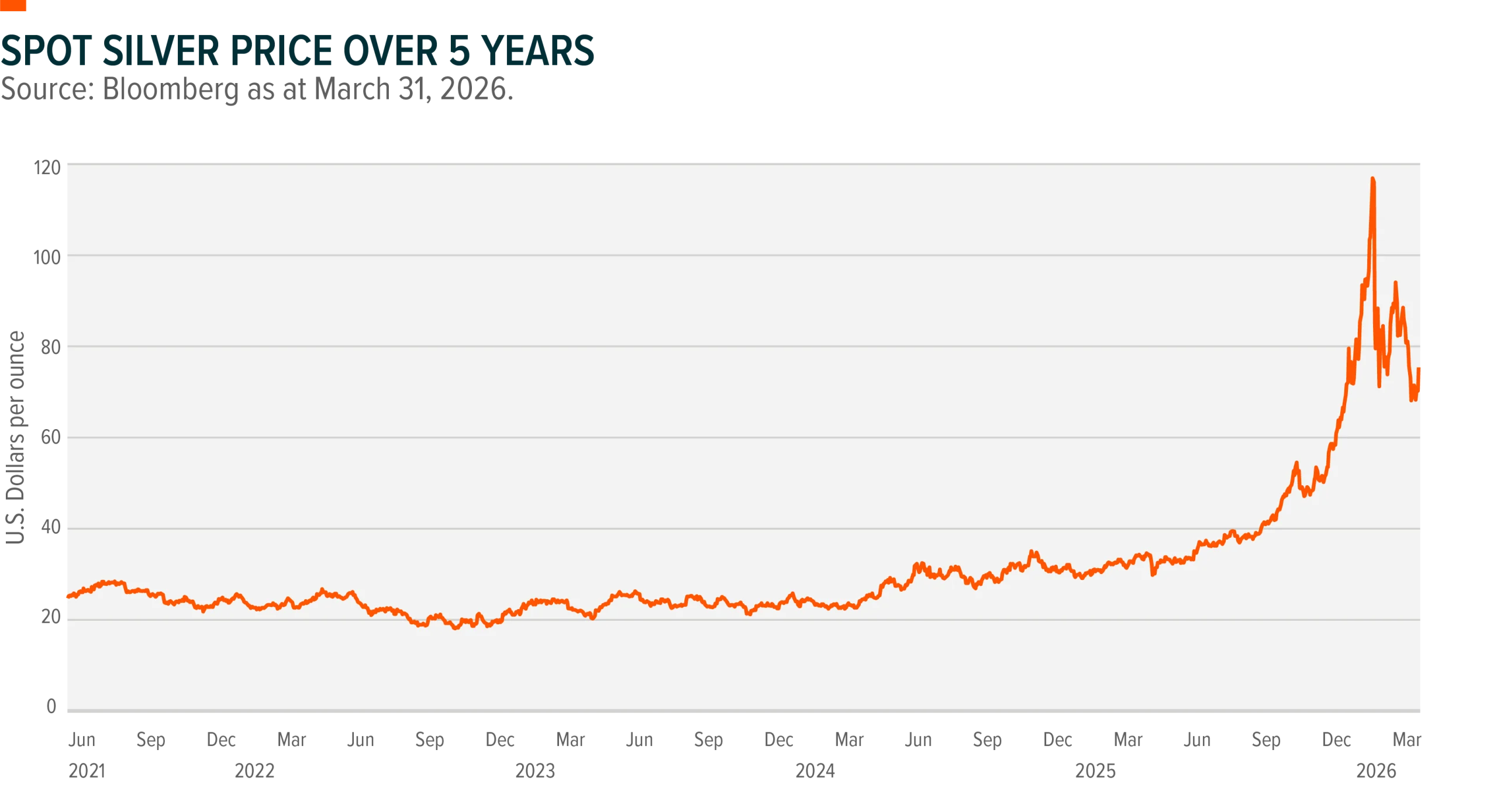
Several tailwinds have converged to support the move. Elevated geopolitical tensions, concerns over the Federal Reserve’s independence, and persistent uncertainty surrounding U.S. policy have continued to attract investment into precious metals.
Continuing physical supply tightness, driven by U.S. tariff concerns, strong investment demand, and an ongoing market deficit, has further amplified upward price momentum. An earlier period of uncertainty around China’s silver export policy briefly raised fears of supply disruptions,2 though those concerns have since eased.
Looking ahead, J.P. Morgan has revised its forecast for average silver prices to $81 per ounce in 2026, which is almost 45% higher than its prior estimate.3

“Given the size of the expected shortages in silver and that it is not a particularly large investment market, when investors and institutions start to increase their positions, the price of silver could move rapidly higher,” Global X Research Analyst Brooke Thackray says.
Silver Market Volatility
Late 2025 saw an unprecedented liquidity squeeze across silver markets. Falling inventories, a dramatic shift of bullion into CME vaults, rising ETF product holdings, and a surge in bar and coin demand all contributed to an unusually tight market.4
The sequence of events began in spring 2025, when President Trump’s tariff policies triggered a large-scale movement of silver from London to CME vaults in New York, with holdings climbing to 531 million ounces, surpassing pandemic-era records. Much of the remaining London inventory was already committed to exchange-traded products, leaving just 17% unallocated.
Simultaneously, surging demand from India pulled additional silver out of global supply chains. By October 2025, tight inventories, logistical disruptions, and surging physical demand had combined to produce a classic silver squeeze.5
New Ways for Silver Equity Exposure
With price volatility characterizing the silver market, investors may wish to consider strategies designed to generate option premiums during periods of market volatility. A covered call approach, for example, can be used to turn market swings into option premium income. It may also limit upside participation in strongly rising markets.
Global X Silver Miners Covered Call ETF (SVCC)
For investors seeking regular distributions alongside a covered call approach, Global X offers the Global X Silver Miners Covered Call ETF (SVCC). SVCC seeks to provide exposure to a broad range of global silver mining companies alongside at least monthly distributions of dividend income and call option premiums. To mitigate downside risk and generate premiums, SVCC employs a dynamic covered call option writing program, generally writing out-of-the-money call options on up to approximately 50% of the portfolio’s value.
Global X Enhanced Silver Miners Covered Call ETF (SVCL)
For investors comfortable with higher risk and seeking a covered call approach combined with leverage, Global X offers the Global X Enhanced Silver Miners Covered Call ETF (SVCL). Designed for experienced investors, SVCL seeks to provide exposure to a broad range of global silver mining companies alongside high distributions of dividend income and call option premiums. In addition to a covered call strategy on up to approximately 50% of portfolio assets, SVCL employs leverage through cash borrowing, generally maintaining a leverage ratio of approximately 125%, to enhance income potential.
Global X Silver Miners Index ETF (SLVX)
For investors looking to gain exposure to a basket of global silver miners without an options overlay, Global X also offers the Global X Silver Miners Index ETF (SLVX). SLVX seeks to replicate, to the extent possible and net of expenses, the performance of the Solactive Global Silver Miners Index, which tracks companies with a business focus within the silver mining industry, including exploration and refining.
Discover our full range of precious metals ETFs here.
Why Silver Miners?
One consideration is diversification. Investing in a broad basket of global mining companies focused on silver reduces reliance on any single company. And in commodity markets, the misfortune of one producer often represents a supply disruption that supports higher prices and improved margins for the remainder of the industry. During periods of geopolitical uncertainty, mining stocks can also provide differentiated exposure relative to other asset classes.
Mining companies also offer operating leverage. When the price of a miner’s underlying commodity rises, revenues increase immediately while the majority of operating costs remain largely unchanged. Incremental price gains can therefore translate into disproportionately large increases in profitability.
Beyond operating leverage, silver mining stocks and exchange traded funds (ETFs) generally tend to be more liquid than physical holdings. Miners may benefit from rising prices by expanding production and increasing margins. And unlike a bar of bullion stored in a vault, mining companies can pay dividends.
Silver Profile
Silver’s industrial applications account for almost 60% of annual demand,6 compared with just over 6% for gold — the remainder of which is tied to jewellery, bullion, and central bank reserves.7 Silver’s industrial uses span electronics (owing to its excellent electrical conductivity), electric vehicle battery technology, and medicine, where its antimicrobial properties are valued.
This gives silver a more diversified demand profile than gold — one influenced by both safe-haven investment flows and the broader trajectory of industrial activity.
Investors also assess silver’s relative value through the gold-to-silver ratio (GSR), which measures how many ounces of silver are required to purchase one ounce of gold.
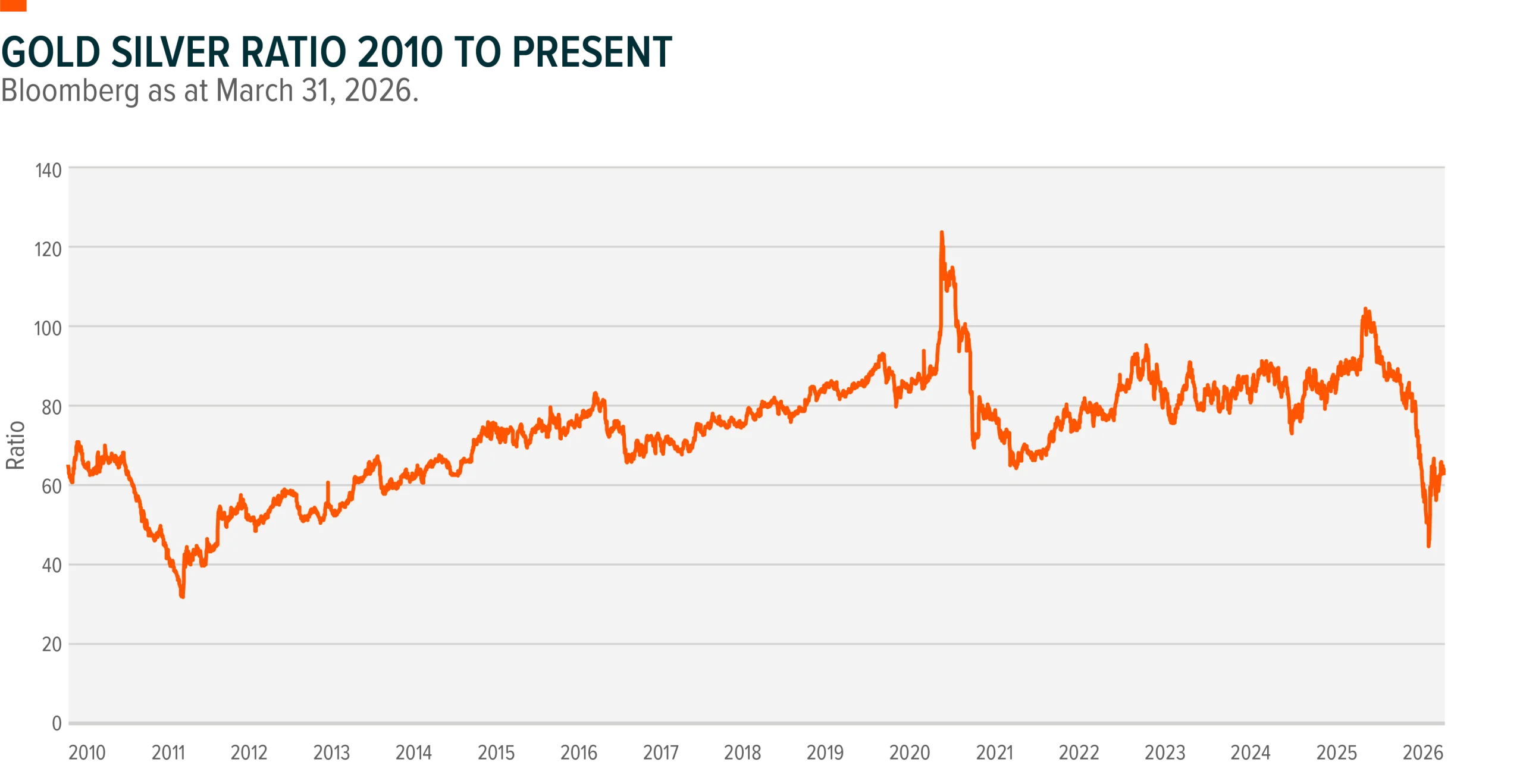
A higher GSR is sometimes interpreted by market participants that silver is undervalued relative to gold. With silver currently trading at a discount to gold and supply continuing to lag demand, investor interest in the metal and the companies that mine it may have further room to grow.
Historically, the GSR has averaged around 60.1 – significant deviations from this level have tended to revert over time.
Demand Picture
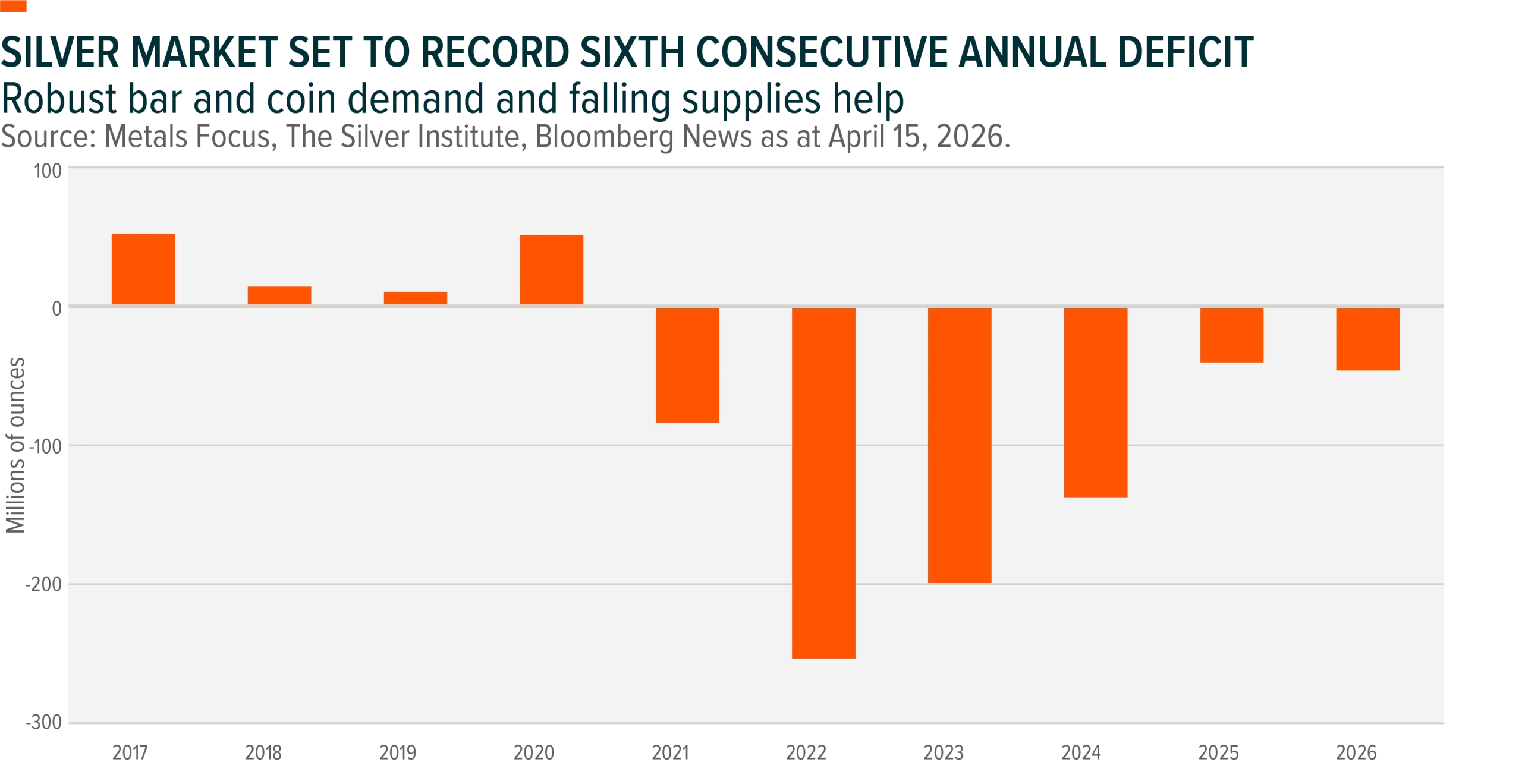
The global silver market is expected to remain in a deficit amid robust demand for bars and coins but declining supplies. This year’s deficit is projected to widen by 15%to 46.3 million ounces.
Total supply is expected to fall2% this year according to The Silver Institute due to a slight drop in mining output and reduced hedging activity amongst producers. A 7% rise in silver recycling may help offset those losses.
To see an example of demand, the Iran conflict and its impact on energy prices has seen soaring demand for solar panels in Europe while exports of Chinese solar panels in March alone reached a new record, as buyers in Asia and Africa stockpiled ahead of expected price increases and fallout from the Iran war boosting demand.
Silver Outlook
Silver’s outlook reflects its dual role as both a precious metal and an industrial input. The market is in its sixth consecutive deficit, driven by strong industrial demand and investment flows.
The Silver Institute says elevated silver prices may begin to weigh on demand. Substitution and efficiency gains—particularly in applications like photovoltaics—could reduce industrial usage, while jewelry and silverware demand may soften. Weaker price sentiment could also impact coin and bar demand.8
However, there are offsetting factors. Growth in data centers, automotive, and infrastructure could support industrial demand. If prices moderate, consumer demand for jewelry may recover. Global investment demand from bullion-holding exchange traded funds (ETFs) remains a longer-term support, despite potential short-term outflows.
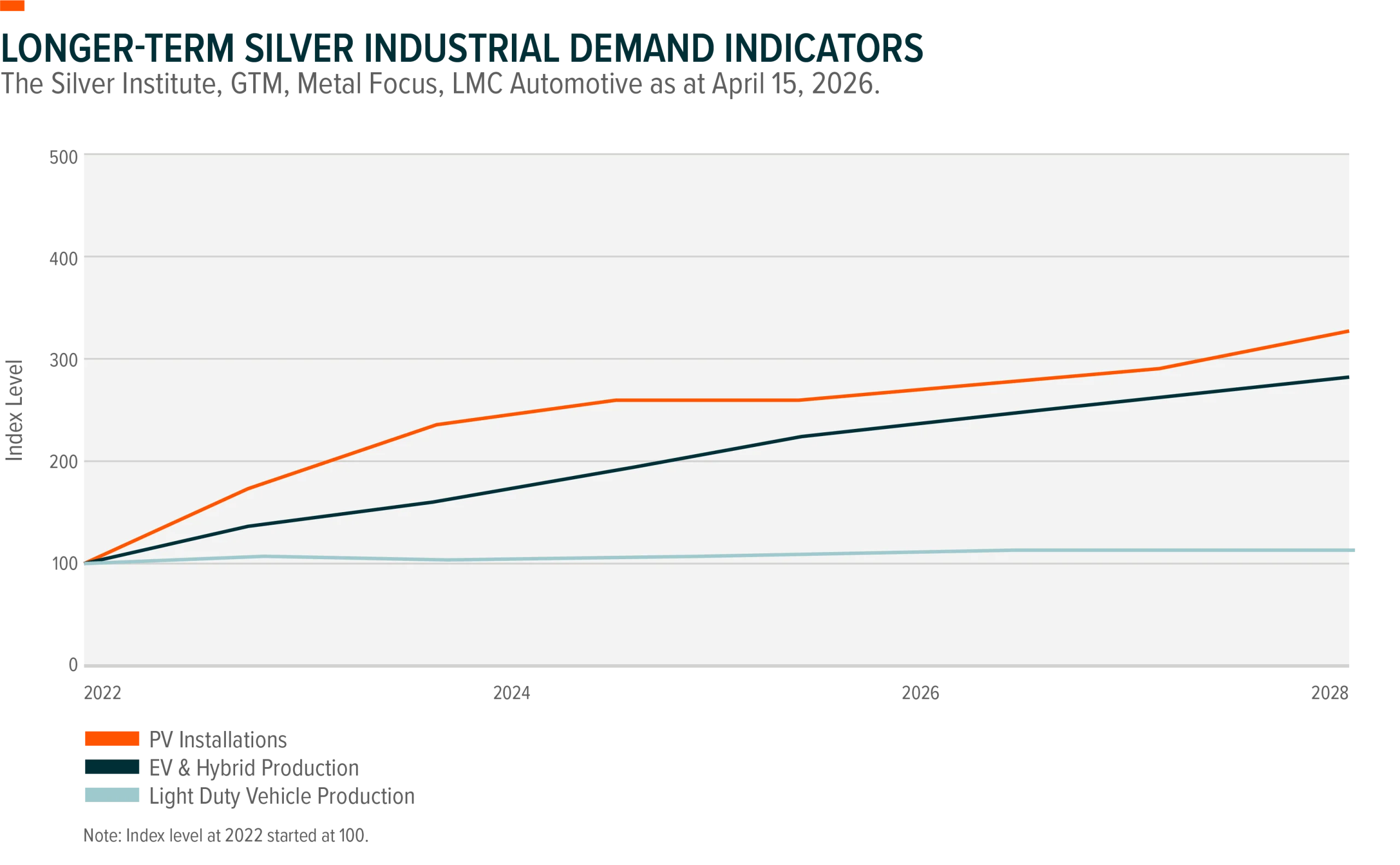
Source: The Silver Institute, GTM, Metals Focus, LMC Automotive as at April 15, 2026
On the supply side, mine production is expected to grow modestly, while recycling depends on sustained high prices and capacity investment.
Overall, the structural deficit is likely to narrow over time, but a sustained surplus remains unlikely. Instead, the market is expected to move toward a more balanced state.
Silver’s price has surged in recent years9 on geopolitical uncertainty, supply deficits, and surging physical demand. Industrial uses account for almost 60%10 of annual silver demand, giving silver a more diversified profile than gold. Global X has added three silver miner-focused ETFs: SVCC, SVCL, and SLVX which span covered call income, leveraged income, and broad index access.
Related ETFs
Global X Silver Miners Index ETF (SLVX)
Global X Silver Miners Covered Call ETF (SVCC)
Global X Enhanced Silver Miners Covered Call ETF (SVCL)
Visit our Precious Metals page for more ETFs.
Sources
1 Source: Bloomberg News, J.P. Morgan Global Research.
2 Source: The Silver Institute.
3 Source: J.P. Morgan Global Research as at February 10, 2026.
4 Source: The Silver Institute as at April 15, 2026.
5 Source: VettaFi Advisor Perspectives as at April 27, 2026.
6 Source: The Silver Institute
7 Source: World Gold Council as at January 29, 2026.
8 Source: Silver Institute, World Silver Survey 2026 (April 15, 2026).
9 Source: Bloomberg News, J.P. Morgan Global Research.
10 Source: The Silver Institute
DISCLAIMERS
Commissions, management fees, and expenses all may be associated with an investment in products (the “Global X Funds”) managed by Global X Investments Canada Inc. The Global X Funds are not guaranteed, their values change frequently and past performance may not be repeated. Certain Global X Funds may have exposure to leveraged investment techniques that magnify gains and losses which may result in greater volatility in value and could be subject to aggressive investment risk and price volatility risk. Such risks are described in the prospectus. The prospectus contains important detailed information about the Global X Funds. Please read the relevant prospectus before investing.
Certain ETFs are alternative investment funds (“Alternative ETFs”) within the meaning of the National Instrument 81-102 Investment Funds (“NI 81-102”) and are permitted to use strategies generally prohibited by conventional mutual funds, such as the ability to invest more than 10% of their net asset value in securities of a single issuer, the ability to borrow cash, to short sell beyond the limits prescribed for conventional mutual funds and to employ leverage of up to 300% of net asset value. While these strategies will only be used in accordance with the investment objectives and strategies of the Alternative ETFs, during certain market conditions they may accelerate the risk that an investment in ETF Shares of such Alternative ETF decreases in value. The Alternative ETFs will comply with all requirements of NI 81-102, as such requirements may be modified by exemptive relief obtained on behalf of the ETF.
SLVX (the “Solactive Index ETF”) is not sponsored, promoted, sold or supported in any other manner by Solactive nor does Solactive offer any express or implicit guarantee or assurance either with regard to the results of using the applicable Underlying Index and/or its trade mark or prices at any time or in any other respect. The Underlying Index is calculated and published by Solactive. Solactive uses its best efforts to ensure that the Underlying Index is calculated correctly. Irrespective of its obligations towards the Solactive Index ETF or the Manager, Solactive has no obligation to point out errors in these Underlying Index to third parties including but not limited to investors and/or financial intermediaries of the Solactive Index ETF. Neither publication of the Underlying Index by Solactive nor the licensing of the Underlying Index or its trade mark for the purpose of use in connection with the Solactive Index ETF constitutes a recommendation by Solactive to invest capital in the Solactive Index ETF nor does it in any way represent an assurance or opinion of Solactive with regard to any investment in the Solactive Index ETF.
Certain statements may constitute a forward-looking statement, including those identified by the expression “expect” and similar expressions (including grammatical variations thereof). The forward-looking statements are not historical facts but reflect the author’s current expectations regarding future results or events. These forward-looking statements are subject to a number of risks and uncertainties that could cause actual results or events to differ materially from current expectations. These and other factors should be considered carefully and readers should not place undue reliance on such forward-looking statements. These forward-looking statements are made as of the date hereof and the authors do not undertake to update any forward-looking statement that is contained herein, whether as a result of new information, future events or otherwise, unless required by applicable law.
This communication is intended for informational purposes only and does not constitute an offer to sell or the solicitation of an offer to purchase investment products (the “Global X Funds”) managed by Global X Investments Canada Inc. and is not, and should not be construed as, investment, tax, legal or accounting advice, and should not be relied upon in that regard. Individuals should seek the advice of professionals, as appropriate, regarding any particular investment. Investors should consult their professional advisors prior to implementing any changes to their investment strategies. These investments may not be suitable to the circumstances of an investor.
All comments, opinions and views expressed are generally based on information available as of the date of publication and should not be considered as advice to purchase or to sell mentioned securities. Before making any investment decision, please consult your investment advisor or advisors.
Global X Investments Canada Inc. (“Global X”) is a wholly owned subsidiary of Mirae Asset Global Investments Co., Ltd. (“Mirae Asset”), the Korea-based asset management entity of Mirae Asset Financial Group. Global X is a corporation existing under the laws of Canada and is the manager, investment manager and trustee of the Global X Funds.
© 2026 Global X Investments Canada Inc. All Rights Reserved.
Published May 19, 2026